

FUKUSHIMA NEWS
~ ~ ~ ~ ~ ~ ~
Help the
NO NUKES Y'ALL
campaign
y'all
Nuclear Watch South is a 501(c)(3) tax-deductible charitable organization.
{ thanks }
PayPal
It's your
safe and secure
way to donate on-line
 |
~ ~ ~ ~ ~ ~ ~
~ ~ ~ ~ ~ ~ ~
~ ~ ~ ~ ~ ~ ~
NEW NUKES for Georgia???

NO THANKS!!!
CLICK HERE
Educating and activating the grassroots to create a
nuclear-free future
~
PO Box 8574
Atlanta, GA 31106
404-378-4263
Cell 404-432-8727
info@nonukesyall.org
NO NUKES Y'ALL!
NUCLEAR WATCH SOUTH | HOME
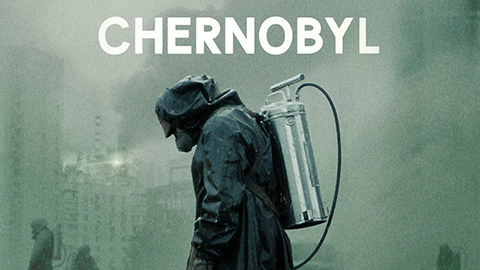
Join Nuclear Watch South
for a special viewing of
acclaimed HBO miniseries CHERNOBYL
in observance of Earth Day and Chernobyl Day 2024
SATURDAY, APRIL 20
1:30 - 4:30 PM
Episodes 1, 2 & 3
SATURDAY, APRIL 27
1:30 - 4:30 PM
Episodes 4 & 5
followed by discussion
FIND OUT MORE >>
U.N. Treaty on the
Prohibition of Nuclear Weapons
Treaty's 3rd Anniversary Celebrated in Sautee, Georgia
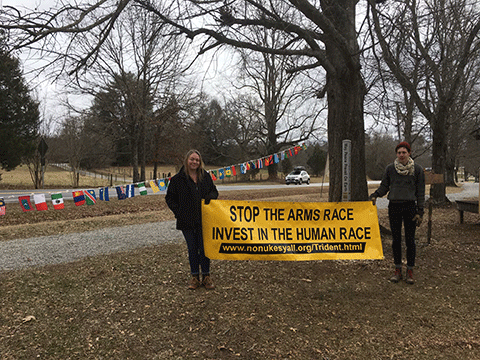 Rebecca Obermeier and John Gagnon participate in the celebration of the 3rd anniversary of the entry into force of the U.N. Treaty on the Prohibition of Nuclear Weapons on January 22, 2023 at the Sautee-Nacoochee Cultural Center. The vigil was held by the Tree of Peace, an oak planted 35 years ago, and the Peace Pole dedicated to Joan O. King and the Treaty in 2021. The flags represent the 70 nations who have ratified the historic treaty making nuclear weapons illegal. Photo by Joanne Sweeney
SAUTEE, GA 1/22/23: Nuclear Watch South board president Joanne Sweeney invited folks to stand for peace and nuclear disarmament on the third anniversary of the U.N. Treaty on the Prohibition of Nuclear Weapons. Following an info and action session at the Sweetwater Coffee House a vigil was held at the Sautee-Nacoochee Cultural Center by the Tree of Peace which was planted in 1988 and the Peace Pole planted in 2021.
READ MORE >>
Georgia Groups Call for Investigation into GA PSC Rubber Stamping of Vogtle Rate Increases
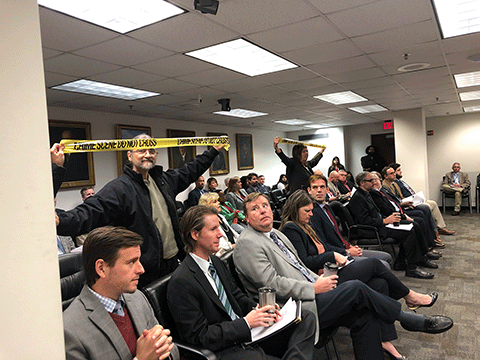 Georgia Power customers express their outrage at the Georgia PSC's unanimous vote to pass $7.56 billion in Vogtle cost overruns onto Georgia electric customers by displaying CRIME SCENE tape immediately following the 12/19/23 vote. Georgia Power made $17 billion in profits during Vogtle construction years. Photo ©2023 Bets Rivard
Same Story, Different State: 26% Electric Rate Increase OK’d by Georgia PSC Follows Similar Corruption Schemes
in Ohio, Illinois, and South Carolina
ATLANTA 12/21/23: The Georgia Public Service Commission (PSC) and Georgia Power are facing renewed accusations of collusion and possible corruption following the recent rate increase approved by the PSC for the Vogtle units 3 and 4 nuclear expansion project. Similar to recent high-profile nuclear corruption scandals in Ohio, Illinois and South Carolina, Georgia’s utility commissioners acted against the best interests of Georgia ratepayers, rubber-stamping cost recovery for mistakes made by Georgia Power.
READ MORE >>
GRAND THEFT NUCLEAR
Public Service Commissioners Display Disregard for Georgia Power's Captive Customers in Hurry-Up Final Hearing on $7.56 Billion in Vogtle Cost Overruns
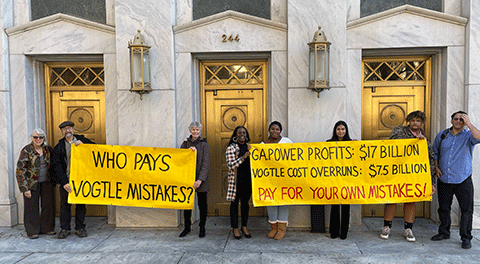 Georgia Power customers attended the final public hearings on Vogtle 3 & 4 cost overruns on December 4, 2023, at Georgia Public Service Commission. Sumter County high school students Joy, Brandy, and Brendan joined activists from Georgia WAND, Nuclear Watch South and Georgia Conservation Voters in front of the 244 Washington Street entrance to the Paul Coverdell Legislative Building. Photo by Glenn Carroll
ATLANTA 12/5/23: Several public witnesses trekked to the Georgia Public Service Commission to speak truth to power in the final Vogtle public hearing which has all the hallmarks of being a fixed game.
Nuclear Watch South and Georgia WAND have participated in Vogtle proceedings at the PSC since the project was first certified in 2009. The groups were astounded when the Public Interest Advocacy arm of the PSC filed a negotiated stipulation simultaneously with Georgia Power's request for $7.56 billion in cost overruns in which they agreed to Georgia Power's request. Even more shocking, public interest groups Georgia Watch and Southern Environmental Law Center (SECL) representing Georgia Interfaith Power and Light (GIPL) and Partnerships for Southern Equity (PSE) signed the agreement as well.
Nuclear Watch South and Georgia WAND followed upon their Petition to Hold in Abeyance with an Open Letter to heads of the PSC and Georgia Power which the groups subsequently published in full-page newspaper ads around the State of Georgia listing more than two dozen groups and 200 individual signers who endorsed our letter.
READ MORE >>
Sign the OPEN LETTER
to Stop the Vogtle Vote until after PSC Elections
OPEN LETTER to PSC Chair Jason Shaw
and Georgia Power CEO Kim Greene
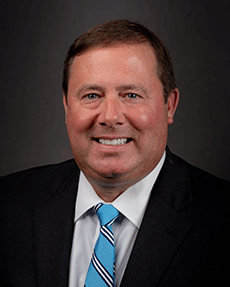

Public Service Commissioner and Chairman Jason Shaw has the legal authority to stop the hearings on who will pay $7.5 billion in Vogtle cost overruns until after long delayed PSC elections are held to fill two commissioners' expired terms. Georgia Power CEO Kim Greene is brand new. Who can blame her for Vogtle? Now she has the power to restore balance to the Vogtle financial morass. Georgia Power made colossal profits during the Vogtle construction years. Georgia Power can pay for its own mistakes.
Invitation from Nuclear Watch South and Georgia WAND
to all Georgia individuals and organizations
CLICK AND SIGN THE OPEN LETTER
READ AND SIGN THE OPEN LETTER >>
Nuclear Watch South and Georgia WAND
Confront PSC with Petition to Delay Hearing on Vogtle Cost Overruns
 Georgia Public Service Commission (l-r) Tricia Pridemore, Fitz Johnson, Jason Shaw, Lauren "Bubba" McDonald, Tim Echols. Johnson's and Echols' terms expired on December 31, 2023. The un-elected commissioners are still being paid and voting on rate increases nearly one year after the election should have been held.
PSC Faces the Largest Rate Increase in Georgia History while Two Commissioners' Terms Expired in 2022
Atlanta, GA 11/2/23: Over legitimate concerns that two Public Service Commissioners' terms expired December 31, 2022, statewide Georgia nonprofits Nuclear Watch South and Georgia WAND filed a Petition to Hold in Abeyance with the Public Service Commission (PSC) on October 27, 2023. The Petition to Hold in Abeyance asks the PSC to delay hearings on Georgia Power's request to recover $7.56 billion in mistakes, delays and cost overruns for Vogtle construction. If approved, it would be the largest rate increase in Georgia history, and petitioners request the PSC to hold the hearings in abeyance until after all five seats on the commission are held by duly elected commissioners.
READ MORE >>
LAST CHANCE PUBLIC HEARING ON VOGTLE
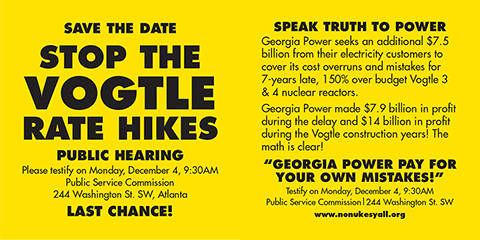
OPPORTUNITY TO GIVE PUBLIC WITNESS TESTIMONY
Monday, December 4, 9:30AM
Georgia Public Service Commission
244 Washington Street SW, Atlanta
Kansas City Peaceworks Activist Found
Not Guilty after Civil Disobedience at
Nuclear Bomb Factory
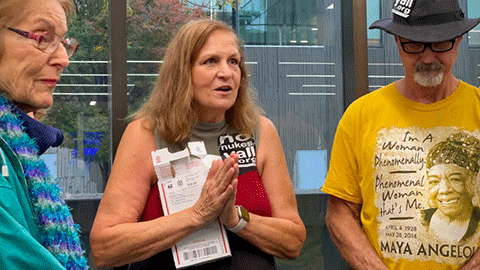 Ann Suellentrop, center, thanks supporters for coming to her trial. At left is Mary Finocchario; at right, Tommy Indigo.
KANSAS CITY 10/25/23: Shock. The courtroom, with about 25 supporters of the defendant, was steeled to hear Judge Anne LaBella say, “Guilty.” The case had been heard. All indicators were that Ann Suellentrop, who pleaded not guilty to committing the crime of trespass on May 29, Memorial Day, at the massive KC MO nuclear weapon production plant, would be declared guilty and most likely endure a lengthy appeal process. The prosecutor had repeatedly objected to Suellentrop’s statements and those of her one witness, retired lawyer Henry Stoever, and only once did the judge not sustain the objections.
The judge made sure Suellentrop had no further comments. The city rested its case. Then, all of a sudden, the prosecutor saw fit to ask the judge to “amend the charge” against Suellentrop. The prosecutor asked that the name Honeywell be added to the charge, since the charge said she trespassed at the Kansas City National Security Campus without mentioning Honeywell Federal Manufacturing and Technologies, which administers the NSC. During the hour-long trial, the prosecutor’s witness had identified himself as a Honeywell lieutenant, a guard. In effect, the complaining witness did not precisely match the charge.
LaBella calmly told the prosecutor concerning the charge, “No. It will stay as it is.” The amendment request came too late. Labella firmly told Ann, “I find you not guilty,” and advised, “You may go now.”
A technicality? A thin thread the judge used because she had reason to believe no crime was committed?
We’ll never know. The result: stunning.
READ THE WHOLE STORY >>
SNAP! CRACKLE! POP!
Vogtle Lurches Towards Babylon
Georgia Citizens Brace for $35 Billion Vogtle Price Tag
as Georgia Power Amasses Billion$ in Record Profit
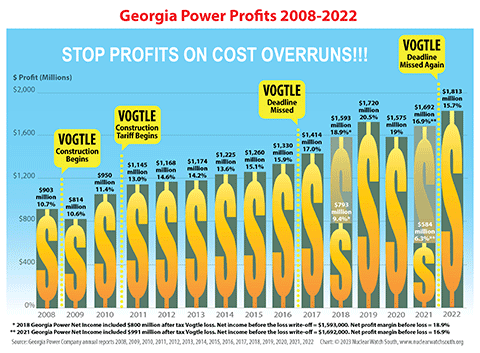
GEORGIA 5/30/2023: Nuclear Watch South marks the occasion of reactor Vogtle 3 reaching its 100% power milestone with the release of Georgia Power's latest performance data.
VOGTLE IS NOT NEEDED For 10 years, Georgia Power's performance data as published in their SEC-filed annual reports have consistently shown that the prospective power from Vogtle 3 and 4 is not needed. Projected electricity demand, Georgia Power's sales, widely missed the 4.1% annual growth predicted at Vogtle certification and has shown a puny .36% average annual increase over the past 10 years. Georgia Power's capacity utilization reveals it is not using 26% of its existing portfolio. Vogtle 3 and 4, with a looming price tag of $35 billion, will add 7.4% to this excess unneeded power.
READ MORE >>
HURRAY FOR PRINTING CENTER USA!
Nice discount for our Whales, Women and Waters of Coastal Georgia coloring book!
VISIT PRINTING CENTER USA
DOWNLOAD COLORING BOOK
Vogtle Reactor #3 Goes Critical
Reactor Becomes Radioactive Waste Burden
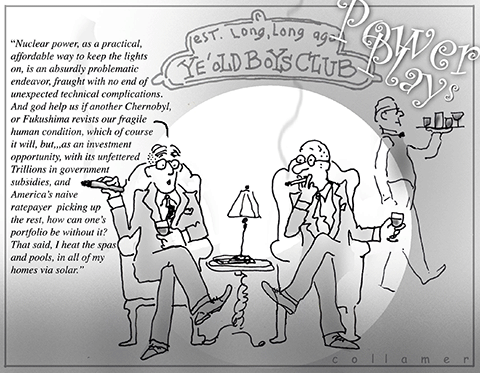 Thanks to San Onofre Safety
ATLANTA 3/6/23: Georgia Power announced that initial criticality has been achieved in Vogtle 3. The announcement also says that Vogtle 3 will not come on-line until May or June 2023 or possibly later.
"It is a sad day for Georgians that the colossally expensive and unneeded Vogtle reactor #3 is now contaminated with nuclear fission by-products and the nuclear core and reactor components have become radioactive waste for which there is still no disposal method," laments Glenn Carroll, coordinator of the statewide environmental group Nuclear Watch South.
READ MORE >>
Welcome the GOLDEN RULE to the Golden Isles
Historic sailboat to visit Brunswick February 14-19, 2023

GEORGIA COAST, February 2023: In 1958, four Quaker peace activists sailed the Golden Rule towards the Marshall Islands with the intent to halt nuclear weapons testing. The US Coast Guard boarded her in Honolulu and arrested her crew, inspiring a global outcry.
The peaceful mission raised awareness of the dangers of radiation, prompting worldwide demands to stop nuclear testing. In 1963, the US, USSR and UK signed a Limited Test Ban Treaty banning all atmospheric nuclear testing. The last underground nuclear explosion was in 1992, and in 2021, nuclear weapons were outlawed internationally by the UN Treaty on the Prohibition of Nuclear Weapons.
READ MORE >>
Nuclear Watch South Votes NO CONFIDENCE
in Plant Vogtle
 Vogtle Unit 3 containment as of July 2022 photo courtesy Georgia Power
GEORGIA 8/3/2022: Nuclear Watch South remains unequivocally opposed to the Vogtle project and greets the announcement that the NRC has completed its safety review, granting permission to Southern Nuclear to load nuclear fuel in Vogtle 3, with grave trepidation.
READ MORE >>
HIROSHIMA and NAGASAKI EVENTS 2022
Saturday, August 6 and Tuesday, August 9

EVENT INFO >>
Georgia Power Profits on Vogtle
Cost Overruns and Delays
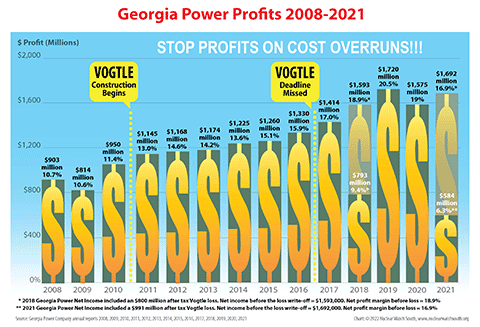
ATLANTA 7/13/22: Georgia Power posted a 6.3% profit in 2021 after writing off $991 million for Vogtle construction cost overruns. The monopoly power company's profits jumped 20% at the commencement of Vogtle construction in 2011 and have steadily increased until ballooning Vogtle cost overruns and delays prompted some large tax write-offs in recent years. According to Georgia Power's annual reports filed with the SEC, the company has made more than $12 billion in profit since Vogtle construction began. Almost $4 billion in Vogtle construction tariffs have been collected, mostly from residential and small business customers during the same time frame.
READ MORE >>
TAKE ACTION: STOP THE BOMB!
Send action letter to stop the proposed plutonium pit factory at Savannah River Site
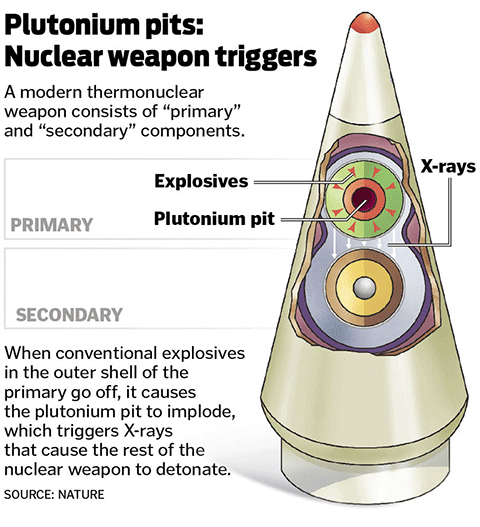
Atlanta 6/3/22: Nuclear Watch South tabled longtime safe energy champion Bonnie Raitt's "Just Like That" show at Chastain Park Amphitheater under fair summer skies and a waxing crescent moon. We invited Bonnie's fans to send an action letter to key House Armed Services committee member Representative Garamendi in opposition to a proposed new factory at Savannah River Site on the Georgia border in South Carolina. The proposal would appropriate $11 billion to convert the failed plutonium MOX fuel factory into an unneeded plutonium pit factory. Plutonium pits are the trigger in a nuclear warhead. Nuclear weapons were outlawed by the U.N. Treaty on the Prohibition of Nuclear Weapons in 2021.
Nuclear Watch South teamed up with SRS Watch who created the letter to bombard Garamendi with citizen letters encouraging him to oppose squandering our tax money on the unnecessary bomb factory. Garamendi has previously signaled his concern about the factory to citizens who have lobbied him directly. SRS Watch and Nuclear Watch South have been on the plutonium case for decades, successfully cancelling the deeply troubled MOX project which was only partially finished after blowing through $8 billion in taxpayer funding.
Bonnie's fans showed considerable savvy about nuclear issues and dozens of fans at three SE concerts took the time to sign and send a well researched and informative letter to Representative Garamendi. Please pile on by sending your letter today!!!
TAKE ACTION!
DOWNLOAD, PRINT, SIGN AND MAIL LETTER
TO STOP THE BOMB PLANT AT SRS
TWO FREE EVENTS JUNE 4 & 5, 2022
CHOOSING HOPE: A Path from Despair to Action
and
COUNCIL OF ALL BEINGS

>> CLICK HERE TO REGISTER <<
MORE INFO >>
OCONEE: Clemson's Aging Neighbor Threatens Campus, Students, Important Watershed
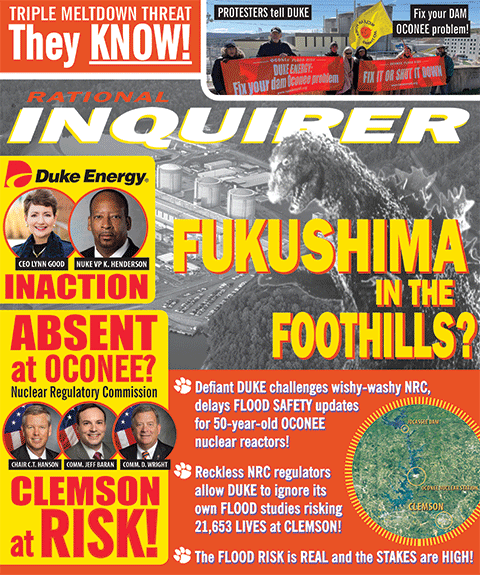
The crown jewel in Nuclear Watch South's recent advertising program to alert the public to the threat of flooding at Oconee Nuclear Station was placed in the Clemson University Tiger campus newspaper's popular April Fools edition.
READ MORE >>
Oconee Flood Risk:
FUKUSHIMA in the FOOTHILLS?
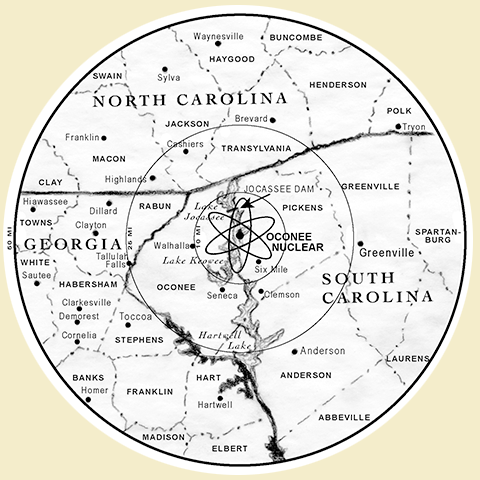
OCONEE NUCLEAR STATION
50-MILE EMERGENCY PLANNING ZONE
3 STATES — 27 COUNTIES — 1,435,128 PEOPLE
TWO SPECIAL EVENTS IN GEORGIA AND SOUTH CAROLINA
WILL OBSERVE FUKUSHIMA 11
Duke Energy’s Oconee nuclear complex is almost 50 years old, as is the Jocassee Dam upstream. Beyond Nuclear’s Linda Pentz and Paul Gunter with Nuclear Regulatory Commission (NRC) whistleblower Jeff Mitman will highlight the risk of meltdowns and radiation releases to the public from neighboring Oconee nuclear reactors if the Jocassee Dam fails, an unacceptably high probability known to both NRC and Duke Energy.
MORE INFO >>
STOP THE VOGTLE SURCHARGE!
www.StopVogtleSurcharge.org
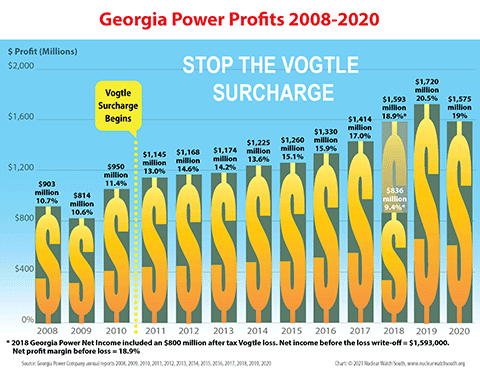
ATLANTA 2/11/2022: A coalition of fed-up constituents are asking the Georgia General Assembly to repeal the Georgia Nuclear Energy Financing Act which legalizes the taking of billions of dollars in electricity surcharges to pay for construction of the troubled Vogtle 3 & 4 reactors near Augusta. Georgia Power's profits surged by more than 20% when they began collecting the surcharge in 2011. During this period Georgia Power has posted $12.8 billion in profit, more than $3.5 billion from surcharges on small business and residential customers' electric bills.
Georgia Power's dismal performance constructing the two additional reactors on the banks of the Savannah River is well documented. Currently the reactors are six years behind schedule and posting more than 100% cost overruns. See:
RATEPAYER ROBBERY
League of Conservation Voters Education Fund
IEEFA U.S.: Price tag for new reactors at Vogtle Plant
in Georgia climbs past $30 billion
HOW PLANT VOGTLE'S BIG FINISH WENT SO WRONG
Atlanta Journal Constitution
www.StopVogtleSurcharge.org
NUCLEAR WEAPONS ARE ILLEGAL!
Beyond Trident celebrates the beginning of the end
of nuclear weapons at the Kings Bay Trident
submarine base
in St. Marys, Georgia
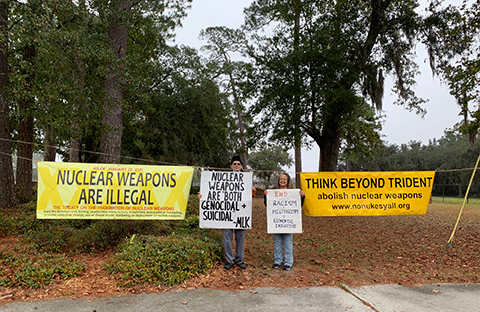 Members of the Beyond Trident campaign brave cold, wet weather and covid to observe the first anniverary of the U.N. Treaty on the Prohibition of Nuclear Weapons at the Kings Bay Trident nuclear submarine base in St. Marys, Georgia. Photo by Teresa Grady. The rollover image is from January 2021: Nuclear Watch South joined Beyond Trident, Susie King Taylor Women's Institute and Ecology Center and the Coastal Black Women's Ocean Memory and Conservation Collective at the gates of the Kings Bay Trident nuclear submarine base in St. Marys, Georgia to celebrate the beginning of the end of nuclear weapons. Photo by Tasha Wei.
St. Marys, GA, 1/21/22: Activists with the Beyond Trident campaign braved cold and rainy weather to vigil at the Kings Bay Trident nuclear submarine base in celebration of the 1st anniversary of the U.N. Treaty on the Prohibition of Nuclear Weapons.
The vigil was one of more than 200 vigils occurring all over the world. The Treaty rendering nuclear weapons manufacture and possession illegal is backed by 59 nations, none of which possess nuclear weapons, all of which recognize that if the nuclear super powers continue the suicidal path of nuclear weapons, it perpetuates a crime against the God-given right of all living things to enjoy and endure in creation.
It is fitting that the nuclear ban treaty anniversary falls exactly one week after Rev. Dr. Martin Luther King Jr.'s birthday. Dr. King was quoted in Liberation magazine, in 1959, when asked his position on nuclear weapons, "I have unequivocally declared my hatred for this most colossal of all evils."
READ MORE >>
BULLDOGGING THE BOONDOGGLE
The Song Remains the Same: CANCEL PLANT VOGTLE!!
 Georgia Power photo from March 2021 shows Vogtle Unit 3 containment still under construction.
ATLANTA 4/30/21: Marking the 35th observance of the ongoing radiological disaster at Chernobyl, Nuclear Watch South released its latest findings on key financial and operating data for Georgia Power, the main owner and lead contractor of still-to-be-finished nuclear reactors on the Savannah River in Georgia.
Since 2013, Nuclear Watch South has been tracking key data from Georgia Power which illustrate the company's actual performance: power demand, power capacity and capacity usage, and profit. With each passing year, the clear trend grows more obvious. Power demand in Georgia is falling an average of 1% per year — even as Georgia's population grew substantially as predicted. Georgia Power is chronically overbuilt by well above 30%, and this is in the wake of shuttering 3,000 megawatts of dirty coal-fired power.
READ MORE >>
4th Annual MAMI WATA RISING
International Conference
HIROSHIMA | NAGASAKI OBSERVANCE
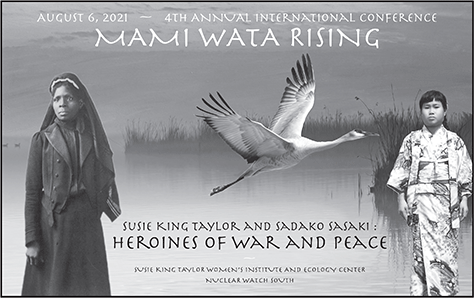
Background photo of sandhill crane flying over Georgia marsh courtesy of Helen D. Young
August 6, 2021
Susie King Taylor and Sadako Sasaki
Heroines of War and Peace
Coastal Georgia, 8/6/21: On August 6, 1848, Susie King Taylor was born, enslaved on a plantation in Liberty County, Georgia. On August 6, 1945, the U.S. detonated an atomic bomb, destroying Sadako Sasaki’s hometown of Hiroshima, Japan.
Susie King Taylor’s escape to freedom at age 13 is just part of the great, uplifting story of survival by one of history’s great champions of literacy. Sadako Sasaki survived the destruction of Hiroshima, but died from radiation fallout a decade later at age 12. Sadako attempted to fold 1,000 origami peace cranes as a wish to get well, inspiring the adoption of the paper crane as an international symbol and call for world peace.
Please join Susie King Taylor Women’s Institute and Ecology Center and Nuclear Watch South to celebrate these heroines of war and peace.
READ MORE >>
Peace Pole Dedication at the
Sautee Nacoochee Center
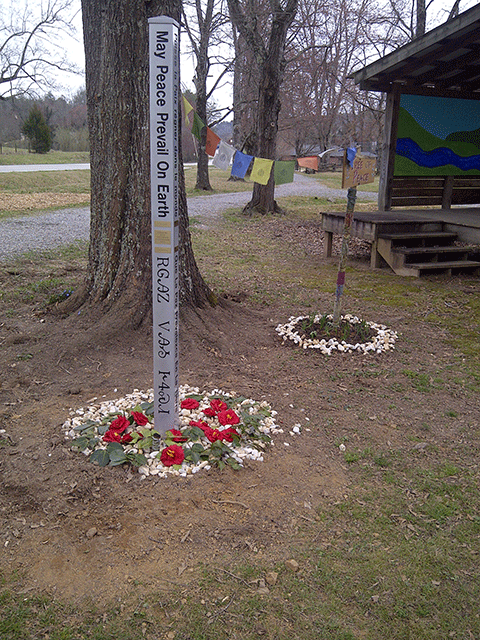
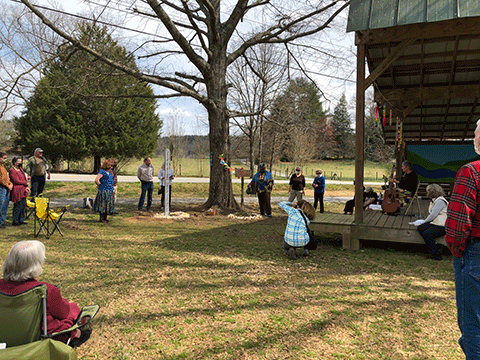 Hermina Glass-Hill, executive director of Susie King Taylor Women's Ecology Institute in Midway, Georgia, conducted a libation ritual, an ancient African drink offering to honor and please the Creator, our sacred ancestors, humans present and not present, as well as the environment. Photo © Betsy Rivard.
"May Peace Prevail on Earth"
1 PM, Saturday, March 13, 2021
Tree of Peace, Sautee Nacoochee Cultural Center
READ MORE >>
THE BEGINNING OF THE END OF
NUCLEAR WEAPONS
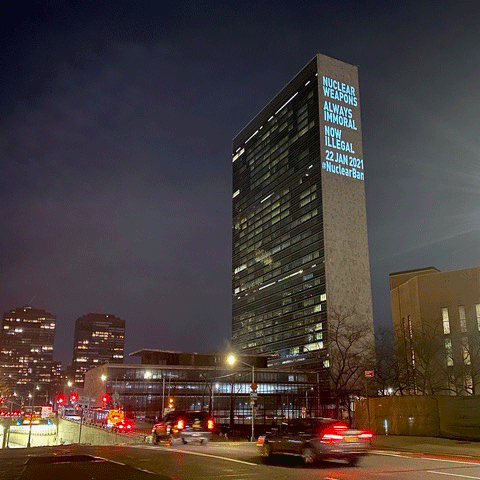 U.N. building in New York lit up in celebration of the U.N. Treaty on the Prohibition of Nuclear Weapons entry into force of international law on January 22, 2021
Peace Vigil, 1-4PM on Friday, January 22, 2021
Stimson Gate of Kings Bay Trident Nuclear Submarine Base
PLANET EARTH 1/22/21: Nuclear Watch South and Beyond Trident are teaming up with Susie King Taylor Women's Ecology Institute and the Black Coastal Women's Ocean Memory and Conservation Collective to hold a peace vigil at the gates of the Kings Bay Trident nuclear submarine base in St. Marys, Georgia, from 1-4PM on Friday, January 22, 2021. The vigil is to celebrate the entry into force of international law of the U.N. Treaty on the Prohibition of Nuclear Weapons. The citizens groups are marking the occasion at Kings Bay to draw attention to the little known fact that 25% of the U.S. nuclear arsenal is deployed from the coast of Georgia and that if Kings Bay were a country, it would be the third largest nuclear weapons state on Earth.
READ MORE >>
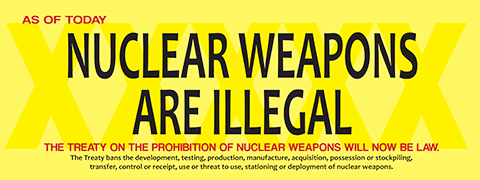
HISTORIC U.N. TREATY ON THE PROHIBITION OF NUCLEAR WEAPONS RATIFIED!!!
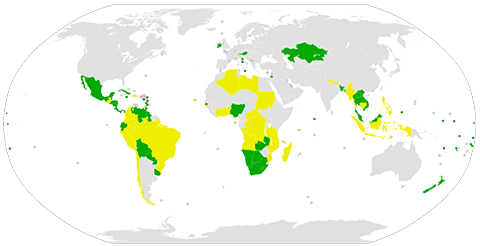
The countries in green ratified the Treaty on the Prohibition of Nuclear Weapons and the countries in yellow are signatories. The countries ratifying the treaty: Antigua and Barbuda, Austria, Bangladesh, Belize, Bolivia, Botswana, Cook Islands, Costa Rica, Cuba, Dominica, Ecuador, El Salvador, Fiji, Gambia, Guyana, The Holy See (Vatican), Honduras, Ireland, Jamaica, Kazakhstan, Kiribati, Laos, Lesotho, Malaysia, Maldives, Malta, Mexico, Namibia, Nauru, New Zealand, Nicaragua, Nigeria, Niue, Palau, Palestine, Panama, Paraguay, Saint Kitts and Nevis, Saint Lucia, Saint Vincent and the Grenadines, Samoa, San Marino, South Africa, Thailand, Trinidad and Tobago, Tuvalu, Uruguay, Vanuatu, Venezuela and Vietnam.
EARTH 10/24/2020: Honduras became the 50th nation to declare war on nuclear weapons with its ratification of the U.N. Treaty on the Prohibition of Nuclear Weapons on October 24, 2020, the 75th anniversary of the founding of the United Nations. The Vatican submitted the first ratification in 2017 shortly after Treaty's adoption by the U.N. The Treaty outlaws nuclear weapons by international law, adding nuclear weapons to other outlawed weapons: land mines, biological weapons and chemical weapons.
READ MORE >>
TRIDENT ON TRIAL
Pre-Sentencing Declaration of Father Steve Kelly, S.J.
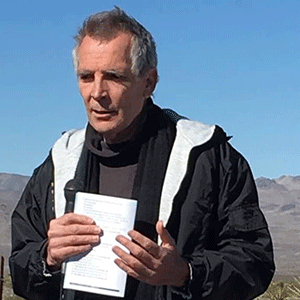 [This statement was filed with the court before Fr. Steve Kelly’s October 15, 2020 sentencing. Father Kelly, pictured right, is one of the Kings Bay Plowshares 7. Father Kelly has been incarcerated at the Glynn County Jail on the coast of Georgia since his participation in the action at the Trident nuclear submarine base on April 4, 2018, the 50th anniversary of the murder of Reverend Dr. Martin Luther King, Jr.]
Presentencing Declaration of Pro Se Defendant's Conscientious Objection To and Non-compliance With Any and All Post-incarceration Conditions
While still in chains, I, pro se defendant Stephen Michael Kelly, S.J., file this declaration in an attempt to remove any ambiguity and avoid all misunderstanding, come time of sentencing.
READ MORE >>
VOGTLE MATH: Numbers Say "Cancel Plant Vogtle"
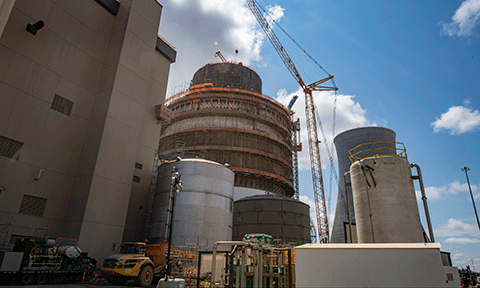 Georgia Power photos from August 2020 show Vogtle 3 construction progress. Rollover image is containment interior. ©2020 Georgia Power
ATLANTA 9/14/2020: Nuclear Watch South released its annual updated performance data culled from Georgia Power’s SEC-filed annual reports today in the wake of the recent filing of Georgia Power’s 23rd Vogtle Construction Monitoring Report (VCM23) to the Georgia Public Service Commission (PSC).
Data from 2009 through 2019, show several clear trends: Georgia Power has an excess of over 30% in its power portfolio and sales have stubbornly remained flat. Vogtle 3 & 4 are simply not needed and should be cancelled concludes the group and its economics expert Steven Prenovitz who compiled and analyzed the figures.
READ MORE >>
HIROSHIMA | NAGASAKI @75
CLICK HERE FOR RECORDED PROGRAM
#BLACKLIVESMATTER AND THE BOMB
Thursday, August 6, 7-8:40PM EST
#BLACKLIVESMATTER AND THE BOMB

Special ZOOM event with Dr. Vincent J. Intondi, author of AFRICAN AMERICANS AGAINST THE BOMB: Nuclear Weapons, Colonialism and the Black Freedom Movement. Join us to commemorate the 75th anniversary of the atomic bombings of Hiroshima and Nagasaki in a moderated discussion with Dr. Intondi following his talk analyzing the connections between racism and the nuclear arms race, including how it relates to local issues in Georgia.
ZOOM LOG-IN INFO + MORE EVENTS >>
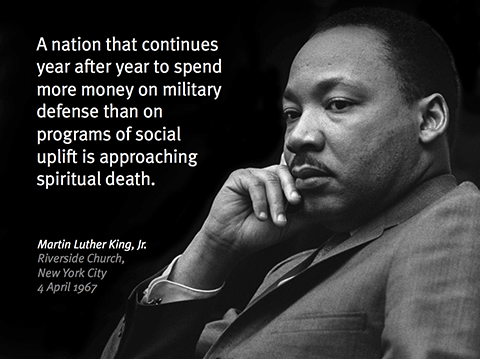
NUCLEAR WEAPONS, MILITARISM, RACISM
To Protect Black Lives,
Georgia’s Laws Have to Change
TAKE ACTION >>
PUBLIC COMMENT NEEDED
"Stop the new nuclear arms race!
Stop nuking our future with more plutonium pits!"
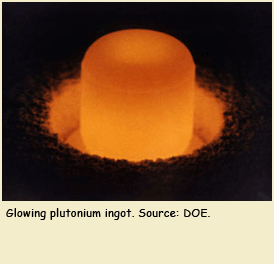 Despite the global health emergency posed by the COVID-19 pandemic, the nuclear death industry is "full torpedoes ahead' with its unholy agenda to start a new global nuclear arms race. On April 3, 2020, the National Nuclear Security Agency (NNSA), a semi-autonomous, super-secretive agency within the U.S. Department of Energy (DOE), published its intent to convert the unfinished MOX factory at Savannah River Site into a factory to manufacture the plutonium cores of nuclear weapons AKA "plutonium pits" and released a draft Environmental Impact Statement (EIS). A virtual public hearing was held on April 30, 2020. The deadline to comment is June 2, 2020. Click on TAKE ACTION >> below for a researched, prepared comment you may edit any way you wish and e-mail to participate in the public comment process.
TAKE ACTION >>
Nuclear Watch South Opposes Vogtle 3 Fuel Load
 This Georgia Power photograph shows the Vogtle 3 containnent vessel as of March 2020. Obviously, it will not be ready for nuclear fuel in November 2020!
ATLANTA 4/20/2020: Nuclear Watch South has docketed a Petition for Public Hearing with the U.S. Nuclear Regulatory Commission (NRC) in opposition to Southern Nuclear/Georgia Power's request for license to load nuclear fuel into Vogtle 3 reactor in November 2020.
In the petition, which is supported by a civil engineer who worked on the team at Vogtle responsible for ITAAC (inspections, tests, analysis and acceptance criteria), the group contends that the information submitted by Southern Nuclear/Georgia Power is grossly incomplete and insufficient to qualify for review by the NRC.
READ MORE >>
Beyond Trident Campaign Launched in Georgia
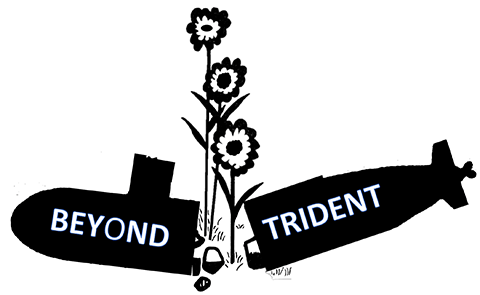
BRUNSWICK, GA 4/4/20: Local activists Robert Randall, Roxane George, Teresa Berrigan Grady and Sarah Cool have been meeting with local and statewide citizen activists to launch a new campaign to bring increased awareness to the impact of Kings Bay Trident nuclear submarine base on the coastal Georgia environment and economy.
The Beyond Trident Campaign aims to resist U.S. Navy plans to expand and modernize Kings Bay to accommodate a new, larger submarine fleet as part of the U.S. instigation of a new global nuclear arms race.
READ MORE >>
EXPLORING THE LEGACY OF THE ATOMIC AGE ON THE SAVANNAH RIVER WATERSHED
READ MORE
SELECT STORIES ABOUT
KINGS BAY PLOWSHARES 7
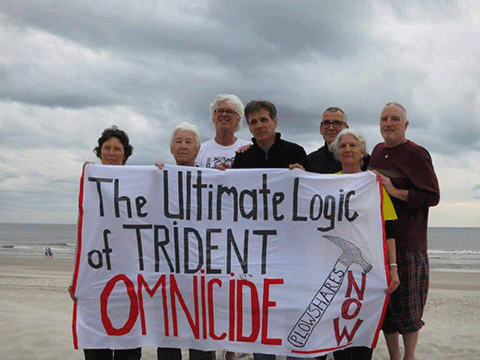
The inside story of anti-nuke activists’
raid on Ga. Navy base
by Joshua Sharpe, Atlanta Journal-Constitution, 12/25/19
Beating Swords into Plowshares
by Patrick O'Neill, OUTRIDER Post
OPINION: U.S. worships capitalism, nuclear weapons
by Joan O. King, Gainesville Times, 12/5/19
Pope Francis at Nagasaki and Hiroshima makes impassioned plea for peace and nuclear disarmament
by Gerard O'Connell, America Magazine, 11/24/19
The Pope and Catholic Radicals Come Together Against Nuclear Weapons
by Paul Elie, The New Yorker, 11/19/19
Religious Beliefs Are Struck Down as Defense for Nuclear Protest
by Sam Husseini, The Nation, 10/31/19
More stories linked at
KINGS BAY PLOWSHARES 7 homepage
TRIDENT ON TRIAL
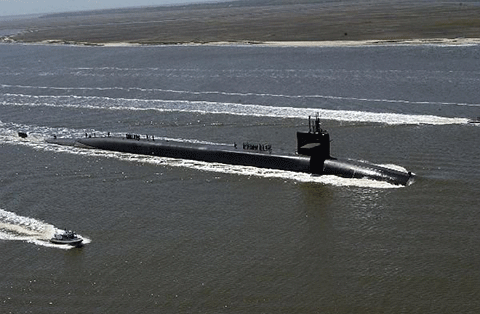
Saturday
OCTOBER 19, 2019, 2-5PM
Vigil at Stimson Gate entrance to Kings Bay
Nuclear Trident Submarine Base, St. Marys, GA
Sunday
OCTOBER 20, 4-7PM
Festival of Hope
featuring Aviva and the Flying Penguins
music, speakers, poets, food,
Dances of Universal Peace and more!
Monday
OCTOBER 21, 2019, 9AM
Kings Bay Plowshares 7 Trial Commences
U.S. District Court
801 Gloucester Street, Brunswick, GA
Kings Bay Plowshares 7 Historic Action Targets Georgia Trident Nuclear Submarine Base
Catholic peace activists confront nuclear weapons and U.S. militarism on 4/4/18 in observance of 50 year anniversary of Martin Luther King's murder
READ MORE >>
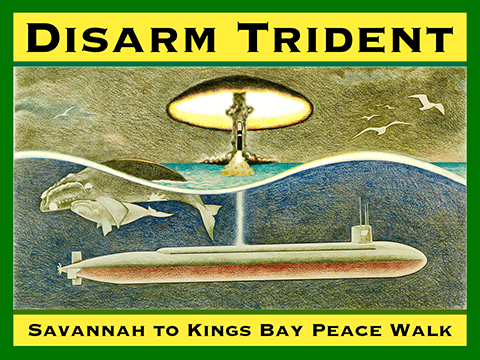
READ MORE >>
VOGTLE 3 & 4 FOR DUMMIES
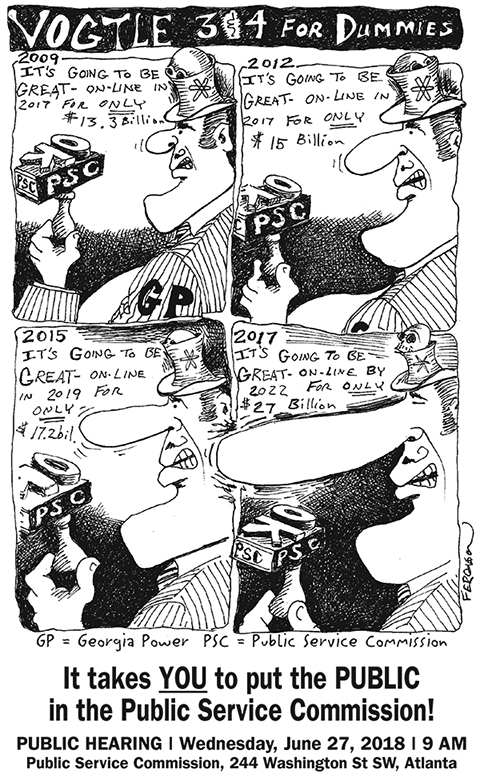
DOWNLOAD CARTOON FLYER
New short film documents
Source to Sea: Savannah River Pilgrimage
© 2018 ANDREW LINKER + DAVID GREEAR
READ MORE ABOUT SAVANNAH RIVER PILGRIMAGE >>
Georgia Power 2017 performance data shows
17% profit from unneeded Vogtle 3 & 4 boondoggle
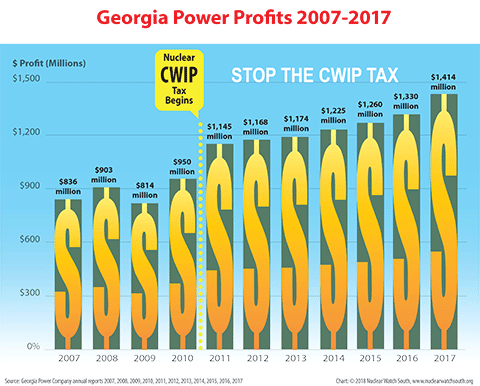
ATLANTA 4/26/18: Nuclear Watch South observes the 32nd anniversary of the Chernobyl disaster by releasing Georgia Power's annual report performance data showing that sales are flat, the company is over-built and the reactors under construction at Vogtle 3 & 4 are not needed.
Despite the devastating financial impact of nuclear construction on almost everyone involved, Georgia Power showed a 17% profit in 2017. The regulated monopoly has posted $10.5 billion in profit since 2009. Georgia Power's rising fortunes are well illustrated in the above chart Georgia Power Profits 2007-2017.
READ MORE >>
Georgia General Assembly Votes to Sunset CWIP
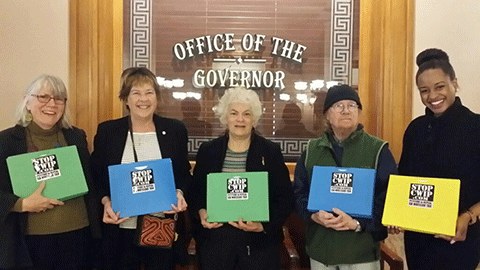
STOP CWIP COALITION DELIVERS PETITION TO STOP CWIP TO GOVERNOR NATHAN DEAL
(L-R) Betsy Rivard, Glenn Carroll, Stephanie Coffin, Tom Ferguson, Lindsay Harper celebrate the bill to amend the Georgia Nuclear Energy Financing Act of 2009 by delivering copies of the petition to governor and key legislators at the end of the 2018 legislative session. Photo © 2018 Gloria Tatum.
ATLANTA 3/27/18 — Representatives of the Stop CWIP Coalition delivered a petition containing more than 3,000 signatures to Governor Nathan Deal’s office in support of the recent passage of Senate Bill 355 to sunset the Georgia Nuclear Energy Financing Act of 2009 with the Vogtle 3 & 4 project. The bill is awaiting the governor's signatures to become law.
READ MORE >>
Nuclear Watch South Demands Investigation into Possible Engineering Malpractice at Vogtle 3 & 4
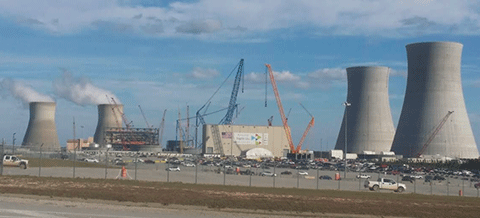 Photo by Gloria Tatum ©2017 courtesy Atlanta Progressive News
ATLANTA 2/9/18: Nuclear Watch South has filed an Amended Request for Investigation with the Georgia Professional License Board of Engineering and Land Surveyors into alleged engineering malpractice at Vogtle 3 & 4. The group originally filed a request in December 2017 and is pressing for action on the serious issue which undermines construction and the ultimate safety of the risky AP1000 nuclear reactors at Vogtle near Augusta, GA.
READ MORE >>
50 WAYS TO STOP PLANT VOGTLE
AVIVA sings testimony "50 Ways to Stop Plant Vogtle" for Georgia Public Service Commission at public hearings about Vogtle cancellation on December 11, 2017
©2017 SAVANNAH MORNING NEWS
Tell the Vogtle co-owners:
DING DONG! The nuke is dead!
Which old nuke? The Vogtle nuke!
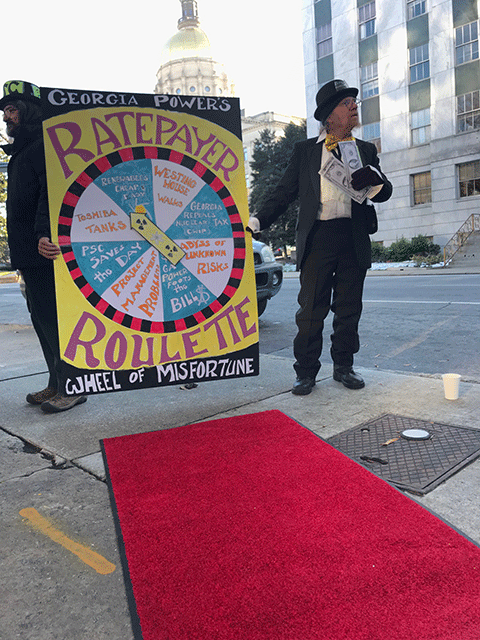
Nuclear Watch South activists Stephen Wing and Tom Ferguson stand with Tom's creative Ratepayer Roulette Wheel of Misfortune outside the Georgia Public Service Commission where the fate of Georgia Power's nuclear construction fiasco Plant Vogtle will be decided on December 21, 2017. Photo by Kelly Jordan.
Take action to encourage Vogtle's co-owners,
the community-based public power co-ops,
to pull the plug on Vogtle 3 & 4 construction!
TAKE ACTION >>
STOP THE PLANT VOGTLE GAMBLE NOW
©2017 GEORGIA GRASSROOTS VIDEO PROJECT
NOW IS THE TIME TO STOP PLANT VOGTLE!
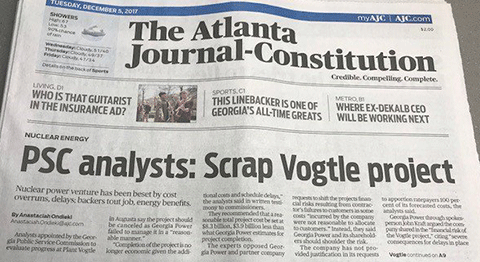
ATLANTA JOURNAL/CONSTITUTION, Tuesday, December 5, 2017
VOGTLE SMACKDOWN AT THE PSC
PUBLIC vs. GEORGIA POWER
 12/11/2017
RALLY, 9:15AM
HEARING, 10AM
12/12-14/2017
HEARINGS, 9AM
Georgia Public Service Commission
244 Washington St.
Atlanta 30334
ATLANTA 12/6/17: Public interest groups and private citizens will converge on the Georgia Public Service Commission in December to confront Georgia Power about its Vogtle 3 & 4 construction fiasco at the 17th Semi-Annual Vogtle Construction Monitoring Review (VCMR). These reviews have occurred roughly every six months since construction commenced on Vogtle 3 & 4 reactors in Burke County in 2010, but this is the first time that Commissioners have officially asked the question whether to cancel the troubled project which is at least five years behind schedule and has doubled in price to $25 billion. The only other reactors under construction in the U.S. were cancelled by South Carolina utilities on July 31, 2017, following the bankruptcy of Westinghouse in March.
Nuclear Watch South, Atlanta Grandmothers for Peace and ARRP (Aging Raging Rate Payers) are holding a rally and encouraging members of the public to speak on the record in the public witness portion of the hearings. Public witness testimony will be accepted at the beginning of each morning and each afternoon session. The PSC has scheduled four days of hearings instead of the usual one day to accommodate a dozen Georgia Power witnesses and a growing roster of intervening parties. The hearing on Monday, December 11 will commence at 10AM and subsequent days will convene at 9AM.
READ MORE >>
"Know When to Hold 'em, Know When to Fold 'em"
YouTube Video highlights local action to Stop Vogtle
©2017 GEORGIA GRASSROOTS VIDEO | JUDY CONDER
ATLANTA July 11, 2017: Last week the Georgia Public Service Commission (PSC) held one of its four hearings per year on Vogtle 3 & 4. It is only the second public hearing since the Vogtle construction consortium got sidelined in bankruptcy court in December 2016. The next public hearing will be sometime this winter. Georgia Power continues to pour $50 million per month of public money into the ill-conceived nuclear reactors.
The public came out in force to speak out on the future of Vogtle which is up for grabs since the power is not needed in a sluggish market and other forms of energy, namely solar and wind, have become cheaper, and as ever, more abundant than nuclear power.
The PSC failed to live up to the "public" in its moniker, as two of the commissioners (McDonald and Wise) didn't even bother to show up, and the acting chair Commissioner Tim Echols bulldozed a major public right to present expert testimony by issuing a last-minute "order" upholding Georgia Power's bully move to block Nuclear Watch South.
Atlanta Grandmothers for Peace and ARRP (Aging Raging Rate Payers) joined more than a dozen public witnesses who gave strong testimony to decertify, PSC-speak for "cancel," the Vogtle construction project and stop collecting the corporate welfare tax that is being taken not only from ordinary citizens, but from Georgia's schools, churches, towns and hospitals.
Many thanks to Georgia Grassroots Video for this informative documentary of a woke public working the rusty machinery of so-called democracy.
READ MORE ABOUT VOGTLE >>
WHAT IS THIS ABOUT?
Nuclear Watch South files to force the PSC to deal with request for emergency hearing
 ATLANTA 6/22/17: Georgia environmental group Nuclear Watch South filed a Mandamus Motion to Compel Response to Request for Emergency Public Hearing on Vogtle 3 & 4 with the Georgia Public Service Commission (PSC) yesterday evening, June 21, 2017. The State Attorney General Chris Carr was also served the motion.
In its motion Nuclear Watch South asserts that the PSC is out of compliance with regulations requiring the Commission to make a timely and definite response to a legitimate public request. The regulation is very specific, and the PSC should have placed Nuclear Watch South’s original Request for Emergency Public Hearing on the agenda of its regularly scheduled May 9, 2017 meeting, or specified an alternative date to consider the request.
READ MORE >>
Nuclear Watch South files direct testimony in 16th Vogtle Semiannual Review
ATLANTA 6/8/17: Nuclear Watch South filed the expert witness testimony of Glenn Carroll this afternoon with the Georgia Public Service Commission in the 16th Semi-Annual Vogtle Construction Monitoring Review.
Ms. Carroll’s testimony drives home the point that Vogtle 3 & 4 power are not needed and Georgia law authorizes the Public Service Commission to decertify unneeded power supply. Updated charts of Georgia Power performance data 2006-2016 are included as well as a new report from the Southern Environmental Law Center which also concludes that Vogtle 3 & 4 are not needed.
READ MORE >>
Coalition of Citizen Groups Rally to Give PSC Message: "Not One More Cent for Vogtle!"
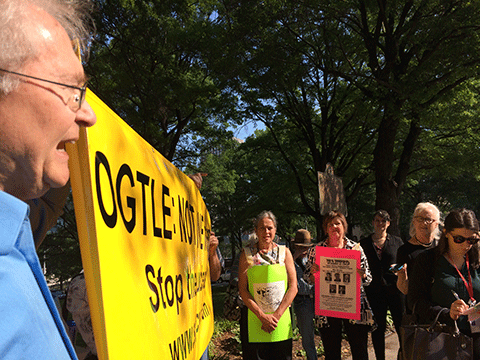 PHOTOS © 2017 Betsy Rivard
ATLANTA 5/12/17: Nuclear Watch South hosted a press conference with Georgia WAND (Women’s Action for New Directions), Atlanta Grandmothers for Peace, ARRP - Aging Raging Rate Payers and Concerned Ratepayers of Georgia prior to the Georgia Public Service Commission's (PSC) first public hearing since high-profile bankruptcies beset the Vogtle construction consortium. The hearing was part of the 16th Semi-Annual Vogtle Construction Monitoring Review process. The next scheduled public hearing on Vogtle will be on June 29 when PSC construction monitors will testify for the PSC staff and Nuclear Watch South will also present expert testimony calling for the shutdown of Vogtle 3 & 4.
READ MORE >>
NOT ONE MORE CENT FOR VOGTLE
Nuclear Watch South files request for emergency public hearing with Public Service Commission on Tax Day
©2017 GEORGIA GRASSROOTS VIDEO | JUDY CONDER
WATCH: "NOT ONE MORE CENT FOR VOGTLE" ON YOUTUBE
ATLANTA 4/19/17: Yesterday Nuclear Watch South filed a Request for Emergency Public Hearing on Vogtle 3 & 4, demanding that the PSC set a schedule and require Georgia Power to submit information that has previously been withheld from the public such as the construction schedule, the cost to cancel and the cost to complete the beleaguered reactor project.
E-mail or call the Georgia Public Service Commissioners and ask them to hold an emergency public hearing before Georgia Power blows any more of OUR MONEY on its risky high-stakes nuclear bet!

DOUG |
TIM |
CHUCK |
STAN |
BUBBA |
|---|
TAX DAY PROTEST
Tell the PSC: NOT ONE MORE CENT FOR VOGTLE
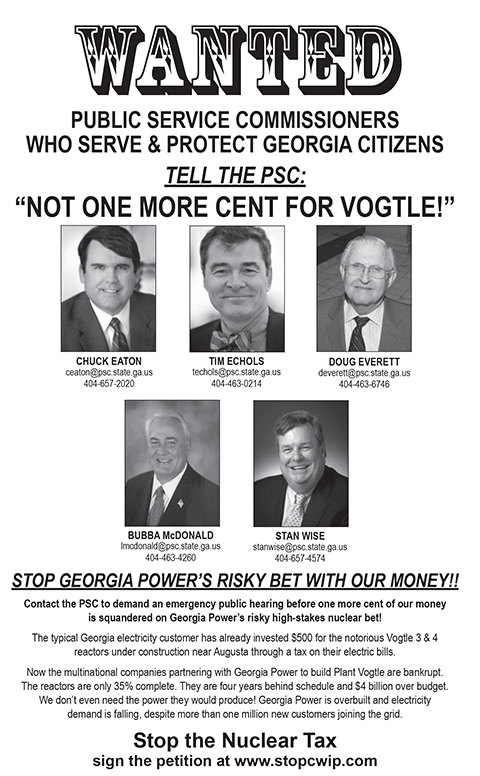
Join the press conference!
9:30 AM, Tuesday, April 18, 2017
244 Washington Street SW, Atlanta
READ MORE >>
Westinghouse Implodes, Vogtle Cancellation Likely?
Timeline of a Boondoggle: Vogtle 3 & 4
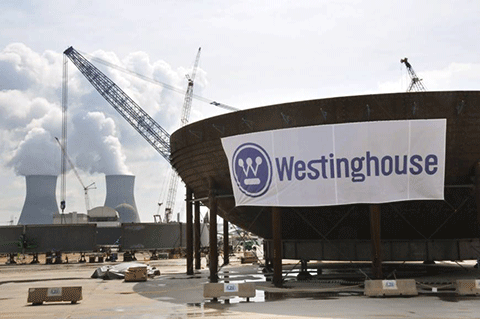
3/29/17 ATLANTA: In the wake of Vogtle lead contractor Westinghouse's bankruptcy announcement yesterday, coupled with Toshiba's revelation that it is $9.9 billion in debt from the four reactors under construction in the U.S. (two in Georgia, two in South Carolina), Atlanta-based environmental group Nuclear Watch South is issuing a detailed timeline of Vogtle 3 & 4 milestones and missteps.
Nuclear Watch South Coordinator Glenn Carroll articulated the group's position in a brief statement:
"Georgia's legislators and Public Service Commissioners enabled Georgia Power to obtain $2 billion in up-front charges from its customers which has increased Georgia Power's profit margin by over 20% in the Vogtle construction years."
READ MORE >>
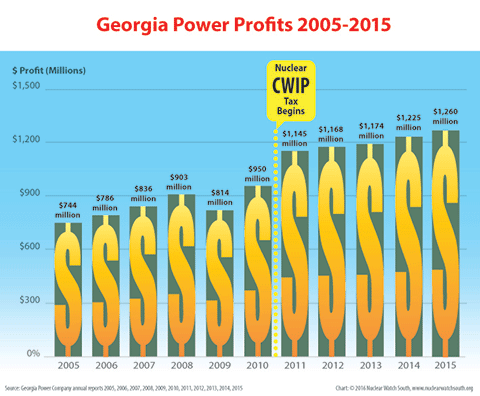
Georgia Power is making excessive profit from the Vogtle 3 & 4 construction boondoggle
Georgia residential and small business electric customers paying nuclear tax for unneeded reactors at Plant Vogtle
10/22/16 ATLANTA: Georgia Power is constructing two reactors at Plant Vogtle near Augusta, GA. The reactors are being funded by an unprecedented nuclear tax on the power bills of Georgia residential and small business customers. Large industrial and retail users are exempt.
Georgia Power predicted huge increases in power demand as Georgia's population keeps growing. But Georgia Power's electricity sales have been flat, even as Georgia has added 1,200,000 new residents. A large percentage of Georgia Power's existing portfolio is going unused despite major cuts in coal powered electricity. Vogtle 3 and 4 would cost $22 billion, more than the whole worth of Georgia Power, yet add only 6% power supply to the grid, a risky source of power that is not needed. Vogtle construction is going badly. The reactors were supposed to be online NOW but are still only 30% finished. The nuclear project is already $3 billion over budget. Now Georgia Power has its hand out to be reimbursed for the cost overruns on the unfinished nuclear boondoggle!
The Georgia Public Service Commission has the power to stop Plant Vogtle construction but has neglected to do so. Here's the real kicker! Georgia Power is making bloated profits from the unnecessary nuclear construction project and the unprecedented nuclear tax it is charging on Georgia Power electric bills.
READ MORE >>
Fear and Loathing at the 14th Semi-Annual Vogtle Construction Monitoring Review
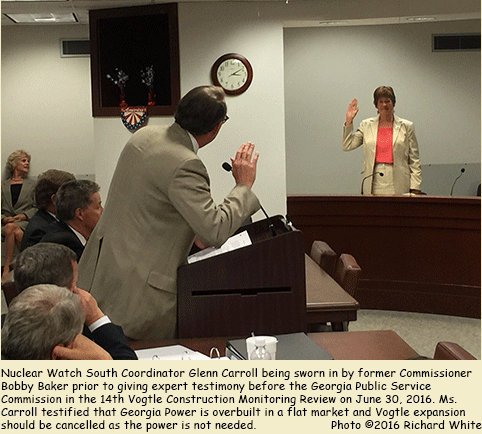
ATLANTA 6/30/16: Only three of five elected Georgia Public Service Commissioners showed up to hear a gloomy forecast from its advisory staff, the Public Interest Advocacy construction monitors and economist that work for the PSC.
Nuclear Watch South Coordinator Glenn Carroll testified to the Georgia Public Service Commission that according to Georgia Power’s own information filed in annual reports with the SEC, Vogtle 3 & 4 do not meet the necessity test for additional capacity resource.
“Back in 2009, Georgia Power predicted it would need new base load power by 2016,” says Ms. Carroll. “Now 2016 is here, and Georgia Power’s electricity sales are the same as they were back then.”
READ MORE >>
Nuclear Watch South Observes Chernobyl 30 with Georgia Power Performance Data Release
ATLANTA 4/26/16: In observance of the 30th anniversary of the Chernobyl nuclear disaster in Ukraine, Nuclear Watch South is releasing updated Georgia Power data which show Vogtle 3 & 4 are not needed and should be cancelled. A press conference and information release in front of Georgia Power headquarters will be held on Tuesday, April 26, 2016, at noon at the corner Baker/Highland and Piedmont in the shadow of Georgia Power headquarters.
READ MORE >>
LUNCH HOUR AT GEORGIA POWER
30 years after Chernobyl explosion ~ a call to action!
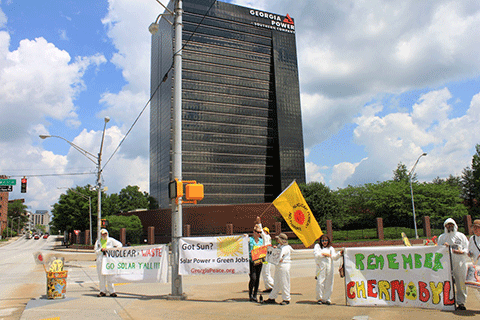
Remember Chernobyl at
Georgia Power headquarters
Tuesday, April 26, 2016
12 Noon - 1PM
READ MORE >>
2016 FUKUSHIMA OBSERVANCE in Athens, Georgia
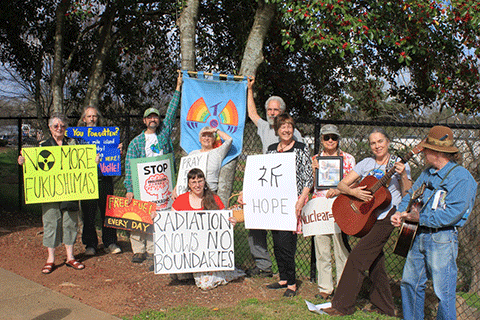
Photo ©2016 Betsy Rivard
NUCLEAR WATCH SOUTH hosted a free educational program, FUKUSHIMA AT 5, at the Athens-Clarke County Library in Athens, Georgia on March 12, 2016. The event was held in observance of the fifth anniversary of the triple nuclear meltdowns at Japan's Fukushima Dai-ichi following the tragic 2011 Tohoku earthquake and tsunami.
READ MORE >>
Testimony too hot for Georgia Power to handle?
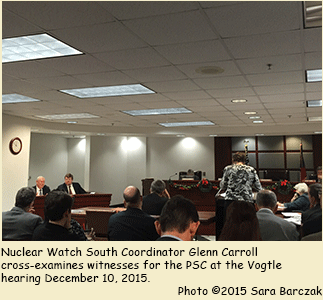 Georgia Power succeeded in its petition to get the Georgia Public Service Commission to suppress testimony given by Glenn Carroll, Nuclear Watch South's coordinator in the 13th Semi-Annual Vogtle Construction Monitoring Review (VCMR). Nuclear Watch South has called for the cancellation of Vogtle 3 & 4 construction based on data from Georgia Power's own annual reports that show the company is overbuilt in a flat market since the 8th VCMR in 2013. In this, the 13th VCMR, Nuclear Watch South introduced a new data set showing that Georgia Power's profits have surged above 20% average higher in the Vogtle construction (and CWIP tax) years. Apparently the profit data is concerning enough that Georgia Power moved to suppress it.
READ NUCLEAR WATCH SOUTH'S TESTIMONY >>
Nuclear Watch South Releases Chart Showing Georgia Power's Profits from Vogtle Boondoggle
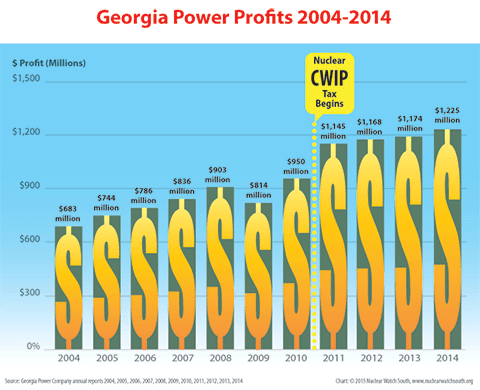
ATLANTA 12/7/15: Nuclear Watch South filed a demonstrative exhibit, GEORGIA POWER PROFITS 2004-2014 with the Georgia Public Service Commission (PSC) in support of direct testimony to be given on Thursday, December 10, 2015 at a public hearing on the 13th Vogtle Construction Monitoring and Review. The colorful chart illustrates a line in the previously submitted Updated Georgia Power Key Financial and Operating Data. Nuclear Watch South is presenting this data to the PSC to prove that Vogtle 3 & 4 are not needed and should be decertified.
READ MORE >>
Nuclear Watch South to PSC: Protect Georgia citizens from Georgia Power's excessive profits
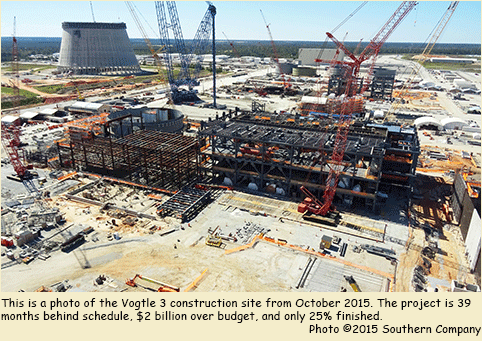
ATLANTA 11/20/15: Nuclear Watch South is releasing updated charts of Georgia Power’s SEC-filed data which show windfall company profits in the years that Vogtle 3 & 4 have been under construction. The information is key to testimony Nuclear Watch South filed with the Georgia Public Service Commission (PSC) in its 13th Semi-Annual Vogtle Construction Monitoring Review of the ongoing necessity and public convenience of Vogtle expansion.
Nuclear Watch South testimony is backed by Georgia Power’s annual report data which show Georgia Power increasing profits even as the company racks up sagging sales and is using less than 60% of its existing capacity.
READ MORE >>
STOP FUKUSHIMA FREEWAYS
Atlanta and Georgia Targets for Radioactive Shipments
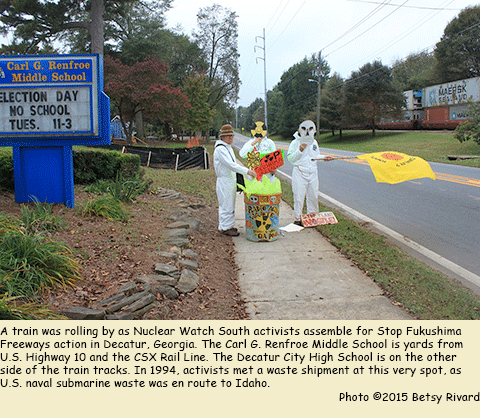
DECATUR 10/29/15 — Over 1,500 intensely radioactive nuclear waste shipments would cross through Georgia, if plans for the country’s first, and scientifically indefensible, nuclear waste repository in Nevada continue to move forward. Today, Nuclear Watch South joins Nuclear Information & Resource Service and dozens of citizens’ environmental and clean energy groups across the country in releasing maps of the likely routes radioactive shipments would use. The groups want residents to weigh in with Congress and decision makers about the dangers of radioactive transport through communities.
Nuclear Watch South released maps of likely Georgia and U.S. transportation routes in front of Renfroe Middle School in Decatur. Georgia, to drive home the point that the middle school is located on U.S. 10 and across the highway from a major CSX rail line. Decatur High School is situated on the other side of the railroad tracks.
READ MORE >>
Nuclear Watch South Denounces PSC Decision
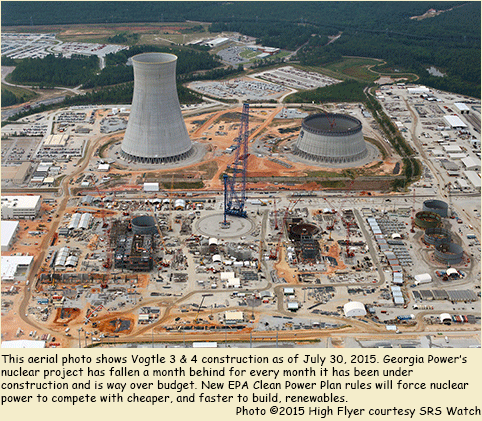
ATLANTA 8/18/15 — In the face of compelling data from 10 years of Georgia Power’s own annual reports showing that the company is overbuilt in a shrinking electricity market, the Georgia Public Service Commission’s (PSC) unquestioning allegiance to the company it is supposed to regulate was displayed in stark relief in its decision today. In a unanimous vote, the PSC not only granted Georgia Power’s requests, but it rejected every recommendation it received from the public and its own staff.
READ MORE >>
Pilgrimage Honors the Savannah River
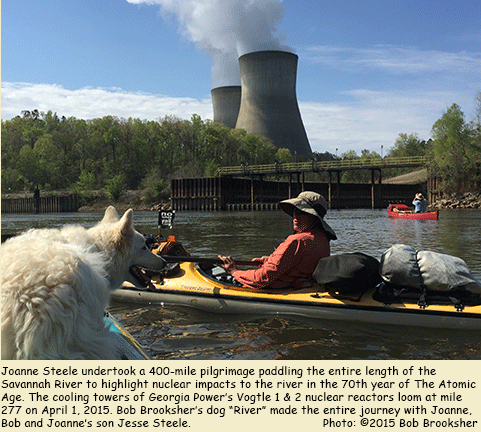
by Joanne Steele
It is not often that a vision comes to fruition with such grace and beauty as did our Source to Sea Savannah River Pilgrimage 2015. We traveled the length of this incredible river system in order to see it, assess its health, learn its history, meet its people, and attempt to raise greater awareness of threats it faces.
READ MORE >>
Nuclear Watch South to PSC: Vogtle Not Needed, Cancel Construction of Vogtle 3&4 Reactors
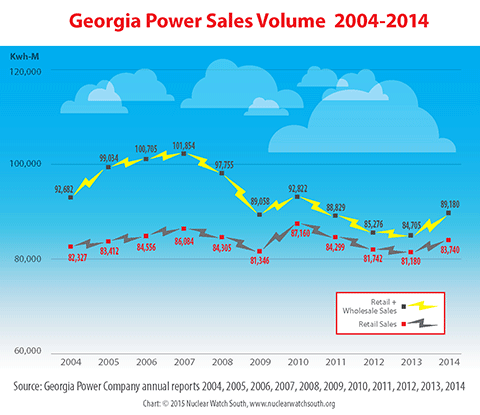
Chart illustrates that Georgia Power's electricity sales have a flat average growth rate over the past decade. The Georgia Public Service Commission issued certification for Vogtle 3 & 4 reactor construction based on Georgia Power forecasts of 4.1% annual growth. Georgia Power's capacity utilization is also depressed (see additional chart) and Nuclear Watch South is calling for the PSC to decertify Vogtle 3 & 4. Data derived from Georgia Power annual reports by Georgia-based economist Steven C. Prenovitz.
ATLANTA June 11, 2015: Nuclear Watch South filed direct testimony in the semi-annual Vogtle construction monitoring docket at the PSC arguing to cancel construction of Plant Vogtle based on a chart of Georgia Power annual report data from the past 10 years showing that Vogtle’s power is not needed.
READ MORE >>
DON'T NUKE THE CLIMATE
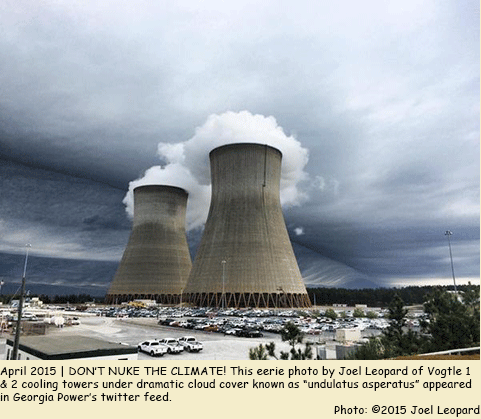
Georgia Congressman John Lewis co-sponsors landmark nuclear disarmament bill
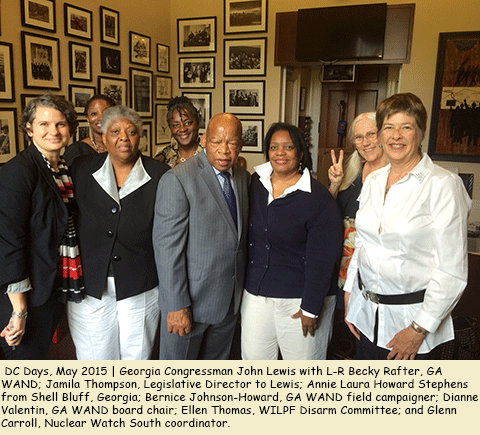
WASHINGTON May 19, 2015 — Nuclear Watch South joined other Alliance for Nuclear Accountability member groups for its annual DC Days lobbying campaign. Georgia delegates met with legendary civil rights activist and longtime Congressman John Lewis to discuss nuclear disarmament. Representative Lewis readily agreed to co-sponsor the landmark nuclear aboliton bill introduced by Representative Eleanor Holmes Norton on Earth Day 2015.
Read HR 1976 - Nuclear Weapons Abolition and Economic and Energy Conversion Act of 2015.
NRC turns blind eye to MOX cyberterrorism risks
Nuclear Watch South's request for public hearing outvoted
WASHINGTON May 14, 2015 —The Nuclear Regulatory Commission (NRC) has ruled that it can grant an operating license to a controversial Department of Energy (DOE) plutonium fuel processing plant without determining that the DOE’s cybersecurity program can adequately protect it from cyberattacks.
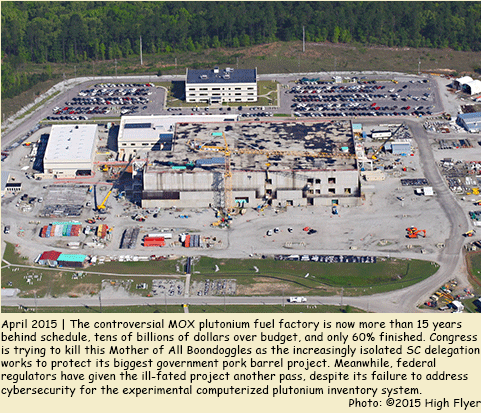
In its April 23 two-to-one decision, NRC commissioners rejected an appeal of a ruling by the agency’s Atomic Safety and Licensing Board (ASLB), which itself was split two-to-one. It was the final issue being litigated in a hearing contesting an operating license for the Mixed Oxide (MOX) Fuel Fabrication Facility, now under construction at the DOE’s Savannah River Site in South Carolina. The facility, whose mission is to convert plutonium from surplus nuclear weapons into commercial nuclear fuel, is years off schedule and is projected to cost tens of billions of dollars more than originally estimated.
READ MORE >>
OCONEE: Fukushima on the Savannah River?
Public program to highlight Oconee reactors on Fukushima anniversary
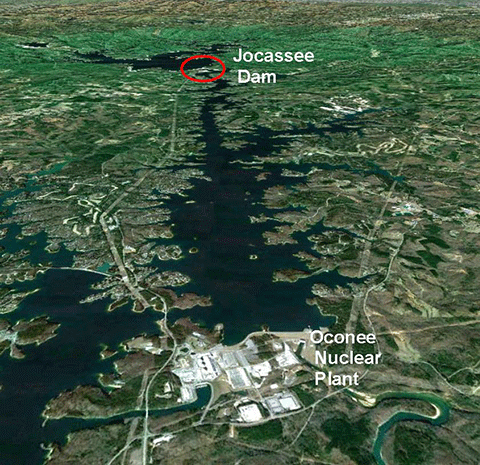
WHAT: "Oconee Nuclear: Fukushima on the Savannah River?”
with Mary Olson, Nuclear Information & Resource Service and
Buzz Williams, Chattooga Conservancy
WHEN: Wednesday, March 11, 2015, 7PM
WHERE: Unitarian Universalist Fellowship of Clemson, 226 Pendleton Road Clemson, SC 29631, 864-654-5959
CLEMSON, SC 3/11/15: A public education program is being offered on the anniversary of the earthquake and tsunami which initiated triple meltdowns at the Fukushima Dai-ichi reactor site in Japan four years ago.
Several local organizations are sponsoring a talk with Nuclear Watch South entitled “Oconee Nuclear: Fukushima on the Savannah River?” at the Unitarian Universalist Fellowship of Clemson at 7PM on March 11, 2015.
According to federal regulators, Duke Energy’s Oconee Nuclear Station has three reactors which are at certain risk of a meltdown if the upstream earthen dam at Jocassee were to break. Regulators and Duke Energy have not yet addressed the threat of flooding to the nuclear plant’s safety systems. In addition, this past summer the Nuclear Regulatory Commission further increased its scrutiny of the Oconee Plant after the plant was issued a violation for failure to identify and correct a leaking crack in a weld on a key safety system.
READ MORE >>
READ THE UNION OF CONCERNED SCIENTISTS REPORT >>
Fireworks at Georgia PSC over Vogtle
ATLANTA 12/16/14: Experts monitoring construction of two additional reactors at Plant Vogtle testified that Georgia Power was imprudent to persist in construction of the complex, first-of-its-kind project without an Integrated Project Schedule. Claudia Collier from Savannah caught dramatic exchange between the Georgia Public Service Commission's construction monitors and Georgia Power's legal counsel in this 16 minute video. ENJOY!
READ MORE ABOUT PROPOSED REACTORS AT PLANT VOGTLE >>
Tell EPA: "Don't Nuke the Climate!"
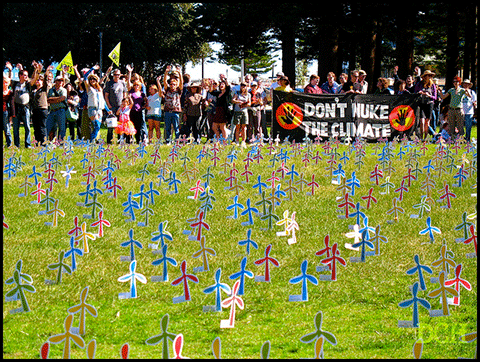
The U.S. Environmental Protection Agency (EPA) is undertaking historic action to limit carbon in the Earth's atmosphere. Humans are in a race against time to curb the emissions spewing into the air, mostly from energy production, in time to prevent catastrophic changes to our home planet's climate. The draft rule contains controversial provisions which support nuclear power.
The deadline to comment on the EPA's draft rule is TODAY, December 1, 2014. Tell the EPA: "Don't Nuke the Climate!"
TAKE ACTION >>
No Nukes Y'all in Creative Loafing
2014 Little 5 Points Halloween Parade
 ©2014 WIL HUGHES CREATIVE LOAFING
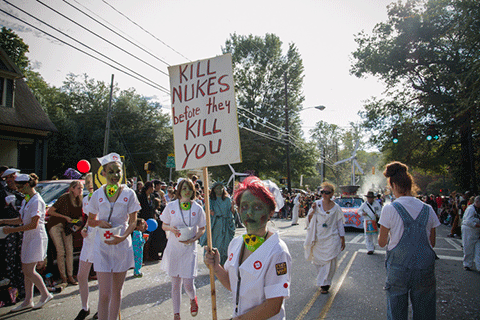
ATLANTA 10/18/14 — Nuclear Watch South entered the annual Little Five Points Halloween Parade with a bevy of zombie nurses who treated the spectators to Atomic Fireballs and special issue orange and black No Nukes Y'all stickers. Our float featured a decrepit Georgia Power cooling tower (and a beautiful windmill). When we passed before the judges' stand the deejay said over the loudspeaker, "Georgia Power!!! Yeah, I paid for that nuke stuff on my bill this month!" Kudos to Creative Loafing for the spreading the word about the CWIP nuclear tax.
TAKE ACTION TO STOP THE CWIP NUCLEAR TAX >>
Who on Earth can stop the Vogtle boondoggle?
~ THESE FIVE GUYS! ~
~ Meet the Georgia Public Service Commission ~
DOUG |
TIM |
CHUCK |
STAN |
BUBBA |
|---|
Tell the PSC:
"VOGTLE IS NOT NEEDED ~ DECERTIFY VOGTLE 3 & 4"
The marketplace for electricity has stalled for the past 10 years and the $18 billion expansion at Georgia Power's Nuclear Plant Vogtle is no longer needed. The Georgia Public Service Commission has the legal responsibility and authority to decertify the unneeded Vogtle reactors. lowering Georgia electricity costs and stopping the wasteful construction of two expensive nuclear reactors at Vogtle. Send an e-mail to the commissioners TODAY!
TAKE ACTION >>
PEOPLE'S CLIMATE MARCH IN ATLANTA
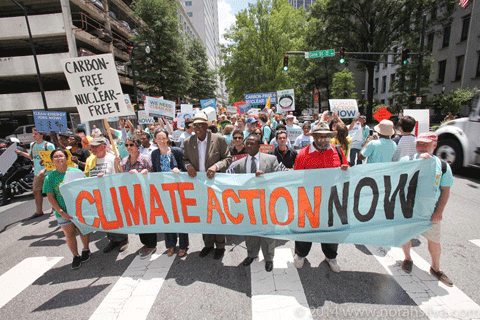
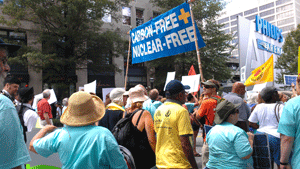 ATLANTA 7/29/14: 700 people marched through downtown Atlanta for a carbon-free and nuclear free future on an unusually comfortable summer day. Nuclear Watch South joined Georgia Sierra Club and dozens of environmental, labor, and human rights organizations alongside people of faith and grandparents concerned about children's health to mobilize awareness and action for a green energy revolution.
The U.S. Environmental Protection Division was in Atlanta to hear two days of public testimony, overwhelmingly supportive of revamping U.S. energy policy to limit the magnitude of carbon emissions currently being dumped into the Earth's atmosphere. A strong CARBON-FREE + NUCLEAR-FREE contingent was on hand to overturn provisions in the current draft law which would support continued reliance and development of poisonous nuclear power reactors.
In Georgia, unbuilt, unneeded Vogtle 3&4 are providing hefty carbon credits to giant polluters Georgia Power and the Southern Company. Continued investment, of mostly public money, in bloated, $18 billion Vogtle reactors would leave little capital available for developing increasingly economic, smaller-scale arrays of solar panels and wind turbines.
TAKE ACTION >>
STAND UP FOR THE SAVANNAH RIVER
Nuclear Water Hog is Not Needed by Georgia Power,
EPD Must Deny Water Permit for Vogtle 3 & 4
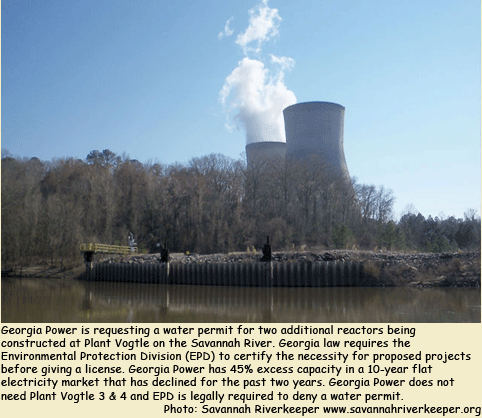
WAYNESBORO, 5/8/14: Georgia Environmental Protection Division (EPD) held a public hearing in response to requests from several parties, including Nuclear Watch South on Southern Nuclear's (division of Southern Company) massive water withdrawal permit request for Georgia Power reactors at Nuclear Plant Vogtle in Burke County, Georgia.
Concerned environmentalists converged from around the state with a long list of concerns about the negative impacts and gargantuan consumption Plant Vogtle would add to the already drought-stressed Savannah River.
According to Georgia Legal Code, EPD is required to consider whether water withdrawals are “reasonably necessary” to meet the applicant's needs. Since Vogtle 3&4 are not needed, Georgia Power therefore does not need to use water from the Savannah River’s and EPD should deny the permit.
READ MORE >>
TAKE ACTION >>
DING DONG! the MOX is (Almost) Dead!
Energy Department Suspends MOX in 2015 Budget Request
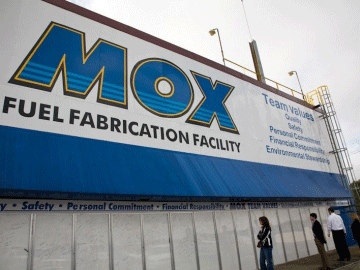 Washington, DC, 3/4/14 – Environmental and non-proliferation groups commended the Department of Energy (DOE) for planning to put the MOX Fuel Fabrication Facility at the Savannah River Site in South Carolina on “cold standby” while it determines an alternative way to dispose of surplus plutonium from nuclear weapons programs.
The MOX program would have used the plutonium to produce fuel for commercial nuclear reactors. Nuclear Watch South has long been concerned about the MOX program’s significant security and safety risks, in addition to its massive cost, now estimated at $30 billion.
READ MORE >>
Remembering Three Mile Island, March 28, 1979
 Middletown, PA 3/28/14 — Dr. Marci R. Culley, Coastal College of Georgia professor and Nuclear Watch South board member attended the annual observance of the meltdown at Three Mile Island (TMI) in Middletown, PA, near the capital city of Harrisburg. Dr. Culley annually participates in the early morning vigil at the gates of TMI.
Dr. Culley did her graduate studies at Penn State and says she was shocked to see Three Mile Island with her own eyes as she was walking to school the first day. Her masters thesis in community psychology focused on longstanding women activists from the TMI area.
In 1999, the 20th anniversary of the TMI meltdown, she committed civil disobedience saying, ''I lived within five miles of the plant for two years. I felt obligated to come back.'' Dr. Culley, who obtained her Ph.D. in community psychology at Missouri State - Kansas City, has returned to TMI every year, and this year is presenting a program at Penn State's Three Mile Island at 35 Conference entitled "TMI and Anti-Nuclear Activism."
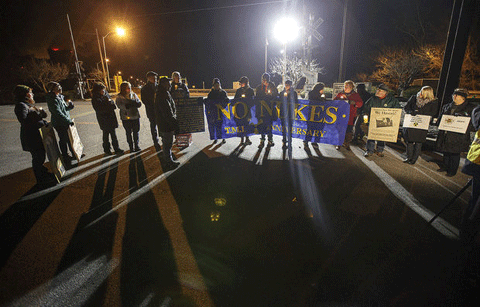
VIDEO "VOICES FROM THE THREE MILE ISLAND ACCIDENT 1979"
READ MORE ABOUT THREE MILE ISLAND AT BEYOND NUCLEAR
Standing for the Future: FUKUSHIMA OBSERVANCE
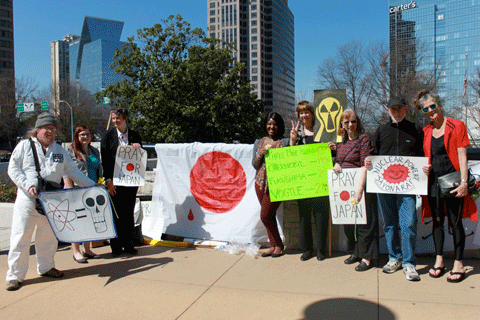
Photo ©2014 Betsy Rivard
ATLANTA 3/11/14 — Activists with Nuclear Watch South and Georgia WAND gathered by the Japanese Consulate in Atlanta to remember the Tohoku earthquake and tsunami that devastated the northern coast of Japan on March 11, 2011, killing nearly 20,000 people and touching off three nuclear meltdowns at Fukushima Dai-ichi nuclear complex. The radiological situation in Japan is still not under control and 135,000 people by official estimates are still evacuated from their ancestral homes.
READ MORE >>
MOX Plutonium Fuel License Approval Granted
Nuclear Watch South: Questions Remain Unanswered
Atlanta, GA, 2/28/14: The Atomic Safety and Licensing Board (ASLB) of the Nuclear Regulatory Commission (NRC) issued its initial decision on the long-running MOX plutonium fuel factory operating license case on February 27, 2014. The two-page decision provides "notice regarding the issuance of initial decision." The full initial decision, because of the sensitive information it contains, is being mailed to the parties by first-class mail. The plutonium factory has been under construction at Savannah River Site (SRS) in South Carolina since 2007.
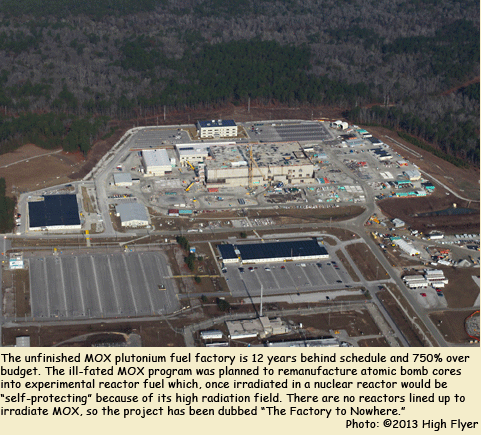
The notice states "the Board rules in favor of the Applicant (Shaw AREVA MOX Services)" on the outstanding security-related contentions brought by Nuclear Watch South and others. Details of the decision, including whether conditions have been attached to the pending license and whether the long-awaited decision was unanimous will be available next week. The full decision will not be publicly available until it undergoes scrutiny and possible redaction by the NRC's Office of Nuclear Security and Incident Response. The decision is subject to appeal and will not be final until it is reviewed and approved by the Commission.
READ MORE >>
Federal Government Backs 6.5 Billion Dollars in Loans for Plant Vogtle
WAYNESBORO 2/20/14: U.S. Secretary of Energy Ernest Moniz came down to Georgia to sign off on giving 6.5 billion in taxpayer dollars to Southern Company, its subsidiary Georgia Power, and Oglethorpe Power to build two nuclear reactors at Plant Vogtle near Augusta.
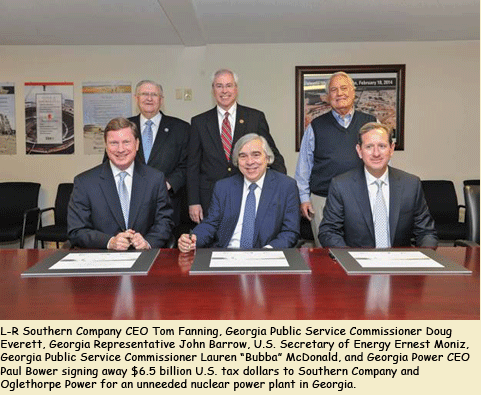
MEAG (Municipal Electric Association of Georgia), 22.7% owner of Vogtle is seeking 1.8 billion dollars in a separate loan guarantee and has a July closure deadline.
The terms of the loan are secret, but Southern Company has divulged to the media that it has put up collateral for the massive loan — namely, the unfinished Vogtle 3 and 4 reactors.
READ MORE >>
READ MORE ABOUT VOGTLE LOAN GUARANTEES >>
CNN: Fukushima IS Pandora's Promise
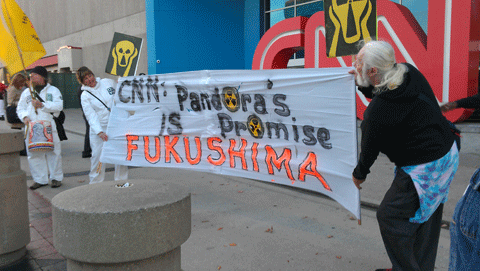 ©2013 Betsy Rivard
11/7/13 ATLANTA: CNN decided to air controversial pro-nuclear film "Pandora's Promise" and found itself at the center of national controversy. A petition with 30,000 signatures got CNN's attention which then scheduled some debates with Sierra Club executive director Michael Brune and Beyond Nuclear Campaigner Kevin Kamps. "Atomic States of America" was aired for free all week on vimeo. And here in Atlanta, Nuclear Watch South figured we should get ourselves downtown to CNN Headquarters for some good old-fashioned street heat! We were well received by the tourists, businessmen and concert goers. Betsy Rivard eluded security for this one photo before we were chased away from the CNN sign!
CNN generated a lot of discussion this week, maybe in the long run it will do some good. Peter Bradford, former Nuclear Regulatory Commissioner, gets our vote for the best quote: "The problem with using nuclear as an answer to climate change is it's so much more expensive than other potential answers," Bradford said. "It's like building palaces to solve a housing shortage, or using caviar to solve world hunger."
SEE MORE PICS AND "LIKE" NUCLEAR WATCH SOUTH ON FACEBOOK
COME ON IN! We're ramping it UP!
 Power my future with clean energy, PLEASE!
HOT NEW REPORT
RENAISSANCE IN REVERSE
by Dr. Mark Cooper
July 2013
BE PART OF THE SOLUTION! Help lead the way from dirty coal and unsafe nuclear to a future powered by harvesting the sun and wind. Start by KNOWING ABOUT IT! Here are some good resources to help us figure out how to create a clean energy future for our planet:
NUCLEAR RENAISSANCE WAS JUST A FAIRY TALE
by Peter Bradford, former Nuclear Regulatory Commissioner, July 2013
WORLD INDUSTRY NUCLEAR STATUS REPORT 2013
by Mycle Schneider and Antony Froggatt, July 2013
STATUS AND TRENDS of the World Nuclear Industry
by Mycle Schneider, WISE-Paris, September 2008
SNAPSHOT OF RENEWABLE ENERGY DEPLOYMENT
by Matthew Johnson, Environment and Energy Study Institute,
January 2011
SOLAR AND NUCLEAR COSTS:
The Historic Crossover: Solar Energy is Now the Better Buy
by John O. Blackburn and Sam Cunningham, July 2010
CARBON-FREE AND NUCLEAR-FREE: A Roadmap for U.S. Energy Policy
by Arjun Makhijani, Ph.D., August 2007
OFFSHORE WIND IN THE ATLANTIC: Growing Momentum for Jobs, Energy Independence, Clean Air, and Wildlife Protection
National Wildlife Federation, 2010
A PATH TO SUSTAINABLE ENERGY BY 2030
by Mark Z. Jacobson and Mark A. Delucchi, November 2009
TAKE ACTION! >>
BONNIE RAITT
STANDING TALL FOR NO NUKES Y'ALL
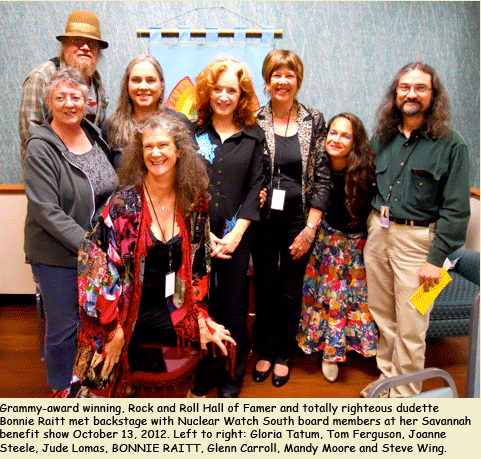
SAVANNAH 10/13/12: Bonnie Raitt put her award-winning SLIPSTREAM tour in support of work to stop U.S. nuclear expansion. In Savannah, Georgia her show benefited NUCLEAR WATCH SOUTH, Alliance for Nuclear Accountability, and South Carolina Sierra Club. NUCLEAR WATCH SOUTH came out in force and launched the Stop CWIP Campaign. We are eternally grateful to Bonnie for a lifetime of commitment to making the world a better place through music and personal activism. Guacamole Fund and Musicians United for Safe Energy produced the green tour. LONG MAY YOU ROCK!!!
Stop Plant Vogtle marches down Peachtree Street
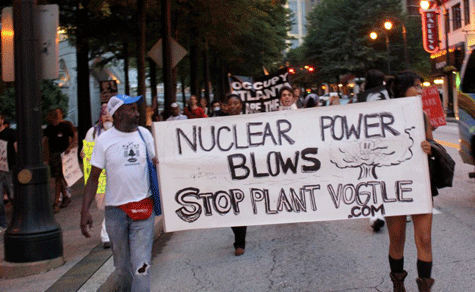
Atlanta, GA 8/28/12: Stop Plant Vogtle campaign was featured in Occupy Atlanta's Tuesday educational march. Hurricane Isaac stopped dumping rain just in time for an evening tour of the Nuclear Regulatory Commission and Georgia Power while handing out fliers to funseekers in downtown Atlanta's tourist district. Of course NUCLEAR WATCH SOUTH was there with hazmat suits and stickers!
TAKE ACTION! >>
Vogtle and Nukes on IF YOU LOVE THIS PLANET
 APRIL 13, 2012: This week on IF YOU LOVE THIS PLANET
Dr. Helen Caldicott interviews long-time antinuclear activist Glenn Carroll, coordinator of Nuclear Watch South, headquartered in Atlanta, GA. Carroll has been committed to grass roots direct action for 25 years, ever since the 1986 Chernobyl meltdown in Russia inspired her to join efforts to stop Vogtle 1 and 2, a nuclear power plant in Waynesboro, Georgia. In this conversation with Dr. Caldicott, Carroll explains the danger posed by the Vogtle 3 and 4 reactors approved for construction at the Vogtle facility, and how utility company Georgia Power and the Nuclear Regulatory Commission are overriding concerns about the environment and human health in order to built the first new nuclear power plants in the U.S. in several decades.
LISTEN >>
TAKE ACTION! >>
Georgia Power Stuck in a Nuclear Jam
Nuclear Watch South coordinator guest blogs at GA WAND
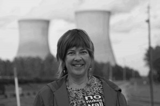 ATLANTA 5/25/12: Everybody except for Georgia is jumping on the wind and solar bandwagon, but Georgia Power is side-lined in a nuclear jam like a horse-buggy manufacturer at the dawning of the Ford assembly line.
Solar and wind are setting records in output and lower costs. Technological breakthroughs in collection and storage of wind and solar have been developed and deployed at such a rapid clip that renewable energy sources are now contributing more electricity to the grid, at lower cost, than nuclear. The historic shift has analysts now harking the coming day when wind and solar will undercut King Coal as well.
READ MORE >>
Nuclear Weapons on a Highway near You
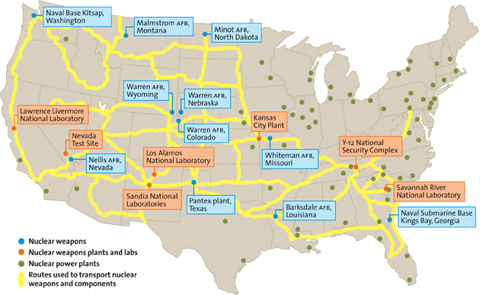
Read about Nuclear Watch South in MOTHER JONES
"To the village square
we must carry the facts
of atomic energy.
From there must come America's voice."
ALBERT EINSTEIN

~~~~~~
~~~~~~
GROUPS WANT FEDS TO PROBE PSC, GEORGIA POWER AFTER RATE INCREASE
by T.A. DeFeo
Washington Examiner
12/23/23
~~~~~~
PETITION TO HOLD IN ABEYANCE
10/27/23
AJC: GROUPS WANT VOGTLE COST HEARINGS HALTED UNTIL GEORGIA PSC ELECTIONS ARE HELD
by Drew Kann
11/2/23
WABE: COURT DECISION EXPECTED SOON ON GEORGIA PUBLIC SERVICE COMMISSION ELECTION
Mary Landers
11/2/23
DELAYED ELECTIONS COULD IMPACT YOUR GEORGIA POWER BILL | HERE'S WHY
11 Alive News
11/3/23
~~~~~~

AUGUST 18-20, 2023
SPARTANBURG, SC
THE MUSIC CAMP
getoffthegridfest.com
Get Off the Grid Fest
featured in
NATURAL AWAKENINGS
~~~~~~
GEORGIA POWER, SOUTHERN CO. HAVE NUKED THEIR CREDIBILITY
by Jay Bookman
Atlanta Journal-Constitution
8/8/17
GEORGIA POWER'S NUCLEAR TOWER TEETERS; EMCs "CONCERNED"
by Matt Kempner
Atlanta Journal-Constitution
8/6/17
~~~~~~
VOGTLE BIG BUCK$ LOTTO

READ THE BLOG @
NO NUKES Y'ALL TIMES
by Glenn Carroll
5/17/17
~~~~~~
RATEPAYERS PUSH VOGTLE CANCELLATION AT PSC NUCLEAR HEARING, VCM 16
by Gloria Tatum
Atlanta Progressive News
5/15/17
ACTIVISTS SEEK EMERGENCY PSC HEARING TO RECONSIDER VOGTLE REACTORS 3,4
by Gloria Tatum
Atlanta Progressive News
4/24/17
~~~~~~

CHERNOBYL LEGACY
photo exhibit by
Paul Fusco
WARNING:GRAPHIC
CLICK HERE
~~~~~~
HOT RESOURCE

~~~~~~
HOW GEORGIA OFFICIALS PANTSED YOU OVER THE HOLIDAYS
by Matt Kempner
Atlanta Journal-Constitution
1/6/17
THANKS TO PSC, UTILITY KEEPS ITS STICKY FINGERS IN PUBLIC'S POCKETS
by Glenn Carroll
Gainesville Times
12/17/16
HAPPY HOLIDAYS FROM GEORGIA POWER
PSC could decide to give you a lump of uranium (and a higher electric bill)
by Sara Barczak
Creative Loafing
12/13/16
THAT'S NOT A CANDY CANE GEORGIA POWER'S HANDING US
by Matt Kempner
Atlanta Journal-Constitution
12/1/16
~~~~~~~
GEORGIANS, GET READY FOR A POWER BILL STICKER SHOCK
by Tom Crawford
Gainesville Times
12/16/15
PSC MEMBERS REST EYES, BAN CRITICAL TESTIMONY DURING VOGTLE HEARING
by Gloria Tatum
Atlanta Progressive News
12/14/15
PLANT VOGTLE WORK GETTING FURTHER BEHIND, EXPERTS TESTIFY
by Walter C. Jones
Augusta Chronicle
12/10/15
MORE DELAYS FOR PLANT VOGTLE
by Walter C. Jones
Athens Banner-Herald
12/10/15
MORE DELAYS FOR PLANT VOGTLE
by Walter C. Jones
Savannah Morning News
12/11/15
VOGTLE NUKES COULD ENCOUNTER MORE DELAYS MONITORS SAY
by Tom Crawford
Georgia Report
12/10/15
~~~~~~~
NUCLEAR WASTE TRANSPORTATION:
IS GEORGIA AT RISK?
by Chris Joyner
Atlanta Journal-Constitution
10/29/15
RADIOACTIVE WASTE COULD BE TRANSPORTED THROUGH CHATTANOOGA,
ANTI-NUCLEAR GROUP SAYS
Chattanooga Times Free Press
10/27/15
SOHN : THERE IS NO GOOD ANSWER FOR STORING NUCLEAR WASTE
by Pam Sohn
Chattanooga Times-Free Press
10/28/15
~~~~~~~
HOT VOGTLE SCOOP
VOGTLE: AT $65 BILLION AND COUNTING, IT'S A CASE STUDY OF NUCLEAR POWER'S STAGGERINGLY AWFUL ECONOMICS
by Michael Mariotte
GreenWorld
8/2/15
VOGTLE NUCLEAR EXPANSION TOTAL COST IS 65 BILLION DOLLARS, FORMER COMMISSIONER SAYS
by Gloria Tatum
Atlanta Progressive News
8/1/15
GEORGIA POWER MUM ON CLAIM THAT NUCLEAR EXPANSION UNNEEDED
by Gloria Tatum
Atlanta Progressive News
7/30/15
HEARING IN VOGTLE REVIEW PROVIDES NEW INFORMATION ON PROJECT'S COST
by Bobby Baker
Clean Energy Blog
7/1/15
~~~~~~~
DIRECT TESTIMONY OF
GLENN CARROLL
ON BEHALF OF
NUCLEAR WATCH SOUTH
6/10/15
GEORGIA POWER KEY FINANCIAL AND OPERATING DATA
2004-2014
by Steven Prenovitz
GEORGIA POWER
SALES VOLUME
2004-2014
GEORGIA POWER
CAPACITY UTILIZATION
2004-2014
~~~~~~
HOT MOX NEWS
MOX RECEIVES GOLDEN HAMMER AWARD
Congress keeps funding overbudget plutonium site with no real customers
by Kellan Howell
Washington Times
5/7/15
~~~~~~
VOGTLE NOT NEEDED
KEY GEORGIA POWER FINANCIAL AND OPERATING DATA
by Steven C. Prenovitz
~~~~~~
HOT REPORTS
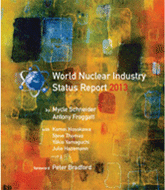
WORLD NUCLEAR INDUSTRY STATUS REPORT 2013
by Mycle Schneider and Antony Froggatt
July 2013
RENAISSANCE IN REVERSE
by Dr. Mark Cooper
July 2013
~~~~~~
LET THE VOGTLE DOE LOAN VANISH
by Kennedy Maize
~~~~~~
ACTIVISTS SEE U.S. NUCLEAR INDUSTRY BEGINNING TO CRUMBLE
by Matthew C. Cardinale
IPS News Agency
~~~~~~
MOX EXPOSED TO
CYBER ATTACKS
by Derreck Asberry
Aiken Standard
NRC PANEL REVIEWS FEARS PLUTONIUM VULNERABLE TO THEFT
by Douglas P. Guarino
NTI
~~~~~~

HOT MOX NEWS!
OBAMA BUDGET PLAN PUTS CONTROVERSIAL PLUTONIUM-CONVERSION FACILITY ON HOLD
by Douglas P. Guarino
Global Security Newswire
3/4/14
~~~~~~
In-depth look at MOX plutonium fuel boondoggle from Center for Public Integrity
by Douglas Birch and
R. Jeffrey Smith
Nuclear Waste:
How a huge U.S. nonproliferation program became a major proliferation concern
6/24/13
Nuclear Waste:
A $1 billion Energy Department project overshoots its budget by 600 percent
6/25/13
Nuclear Waste: Extremism in defense of federally-paid jobs is no vice in South Carolina
6/26/13
Nuclear Waste: Washington has ignored a cheaper way to dispose of its plutonium — until now
6/27/13
~~~~~~
KNOW ABOUT IT
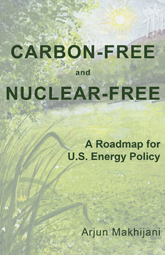
Breakthrough study by IEER proves we can get off coal, oil and nuclear by 2040
FREE DOWNLOAD
READ THE SUMMARY
VISIT THE WEBSITE
~~~~~~
RESOURCES
DORO-CHIBA
QUAKE REPORT
April 2012
FAIREWINDS.ORG
FUKUSHIMA UPDATES
ENFORMABLE
NUCLEAR NEWS
U.S. NUCLEAR POWER SAFETY ONE YEAR AFTER FUKUSHIMA
Union of Concerned Scientists
FUKUSHIMA TIMELINE
Scientific American
ALL THINGS NUCLEAR
Union of Concerned Scientists
~~~~~~
HOT NEWS!
Worldwatch Institute report finds renewables output surpasses nuclear in 2010
NUCLEAR POWER IN A POST-FUKUSHIMA WORLD
25 Years After the Chernobyl Accident
draft
World Nuclear Industry
Status Report 2010–2011
by
Mycle Schneider,
Antony Froggatt,
Steve Thomas