

FUKUSHIMA NEWS
~ ~ ~ ~ ~ ~ ~
Help the
NO NUKES Y'ALL
campaign
y'all
Nuclear Watch South is a 501(c)(3) tax-deductible charitable organization.
{ thanks }
PayPal
It's your
safe and secure
way to donate on-line
 |
~ ~ ~ ~ ~ ~ ~
MOX RESOURCES
Read more about the U.S. plutonium program
PLUTONIUM WAITS
PLUTONIUM IMMOBILIZATION
PLUTONIUM TRUCK PHOTOS
"MOX Plan Hits Roadblock"
"Nuclear Fuel Test Failure Raises Concerns"
"Nuke Transport
Photos Released"
ANA MOX FACTS
GREENPEACE
MOX FACTS
MORE GREENPEACE
MOX FACTS
MORE GREENPEACE
PLUTONIUM
NRC MOX LETTER
NRC MOX WEBSITE
NRC MOX LICENSING
MOX LICENSE APPLICATION
RED OIL REPORT
Educating and activating the grassroots to create a
nuclear-free future
~
PO Box 8574
Atlanta, GA 31106
404-378-4263
Cell 404-432-8727
info@nonukesyall.org
NO NUKES Y'ALL!
PLUTONIUM | MOX PLUTONIUM FUEL
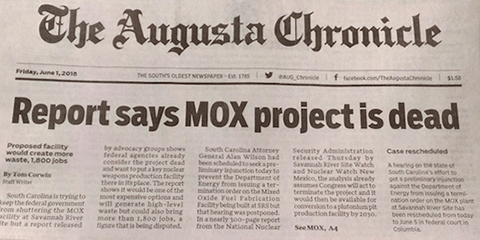
Finally ... really ...
MOX IS DEAD!
READ THE ARTICLE HERE
DING DONG! the MOX is (Almost) Dead!
Energy Department Suspends MOX in 2015 Budget Request
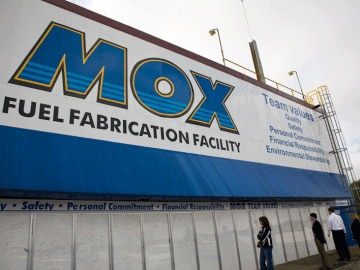 Washington, D.C. March 4, 2014 – Environmental and non-proliferation groups commended the Department of Energy (DOE) for planning to put the MOX Fuel Fabrication Facility at the Savannah River Site in South Carolina on “cold standby” while it determines an alternative way to dispose of surplus plutonium from nuclear weapons programs.
The MOX program would have used the plutonium to produce fuel for commercial nuclear reactors. Nuclear Watch South has long been concerned about the MOX program’s significant security and safety risks, in addition to its massive cost, now estimated at $30 billion.
“Converting this plutonium to a form that would be harder to steal or reuse in nuclear weapons is an essential long-term goal,” says Edwin Lyman, a senior scientist in the UCS Global Security Program and who is serving as expert witness in Nuclear Watch South's legal intervention. “But the MOX strategy would have greatly increased near-term risks by making it easier for terrorists to steal plutonium during processing, transport or storage at reactors.”
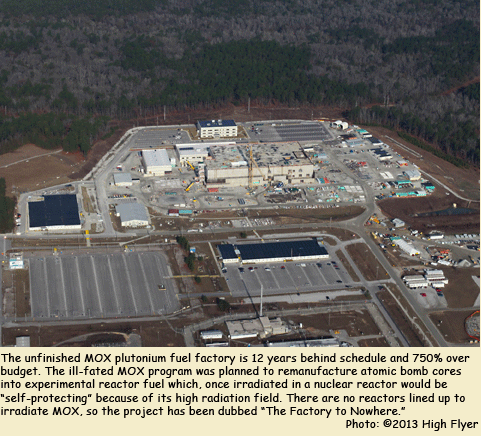
The budget request (see page 384) for the Department of Energy is $27.9 billion and the amount for "fissile material disposition" is $311 million, of which only $211 million is for MOX, a considerable reduction from Fiscal Year 2014. The funding is earmarked for placing the MOX building in a cold standby that meets DOE regulations.
The budget summary states: “Following a year-long review of the plutonium disposition program, the Budget provides funding to place the Mixed Oxide (MOX) Fuel Fabrication Facility in South Carolina into cold-standby. NNSA is evaluating alternative plutonium disposition technologies to MOX that will achieve a safe and secure solution more quickly and cost effectively. The Administration remains committed to the U.S.-Russia Plutonium Management and Disposition Agreement, and will work with its Russian partners to achieve the goals of the agreement in a mutually beneficial manner.”
Tom Clements, adviser to the South Carolina Chapter of the Sierra Club says, “This move by DOE is welcome as the MOX program is unsustainable due to run-away costs and the shut-down of the project must be carried out quickly while DOE immediately initiates options to dispose of plutonium as waste. This is only a request but if it goes through MOX is dead."
“We have long called on DOE to abandon the mismanaged MOX project and implement viable disposition alternatives and this request finally gets DOE on the right track,” said Clements.
“It is most unfortunate that self-serving politicians such as Senator Lindsey Graham and Representative Joe Wilson have protected the failed MOX project from proper oversight, causing the budget to soar to levels where it was no longer viable,” added Clements. “The MOX project is a text-book case in how not to implement a costly, complicated program and taxpayers can only hope that the project is quickly terminated.”
Clements has estimated that about $5 billion has been spent so far on the MOX program and that another $22 billion would have to be spent if the project was carried out over the next 20 years. No utilities have stepped forward to offer nuclear reactors to use any MOX fuel, which has made the construction of the $8 billion MOX plant a facility without customers and notorious as "the factory to nowhere."
“With the prospect of more cost increases and no customers to use any MOX fuel that the MOX factory might produce, DOE had no other option but to put the project on ice,” said Clements. "The Tennessee Valley Authority should now announce that it will formally disengage from the DOE's failed MOX project."
Dr. Lyman asserts that using plutonium-based fuel in nuclear reactors would increase the risk of a serious nuclear reactor accident. “The DOE has already wasted billions on this risky project. It’s time to pursue a cheaper and safer alternative,” said Lyman, a physicist. “Congress should follow the administration’s lead and terminate this ill-advised program.”
OINK: TV ad skewers Lindsey Graham's pork-barrel plutonium MOX boondoggle
WASHINGTON, D.C. – June 19, 2013 -- If it walks like pork and sounds like pork -- even with a French accent -- it's probably pork. And pork is what the Department of Energy’s MOX Project is.
As a key House subcommittee takes up funding for the problem-plagued, budget-busting nuclear fuel program, Senator Lindsey Graham’s obsessive support of the project at the Department of Energy’s Savannah River site in his home state of South Carolina is being targeted in an off-beat, on-target TV ad from Friends of the Earth.
The Obama Administration has requested a large cut to the program both this year and in later years, possibly terminating the project. Friends of the Earth, Taxpayers for Common Sense and other environmental and public interest groups are campaigning for an end to MOX funding.
The ad features pigs in lobbyists' suits with a twist at the end after it is revealed that one of the main beneficiaries of Graham's MOX madness is a French company, "sending tax dollars overseas."
"We wanted to call out Senator Graham's determination to continue uncontrolled spending on a project that is $6 billion over budget, behind schedule and has no future market for its product," Tom Clements, Friends of the Earth's South Carolina-based nuclear campaigner. "MOX has become nothing more than a pork-barrel project used by Senator Graham to line the pockets of special interests." The French company AREVA is a main beneficiary of the MOX plant design and construction.
The 30-second “Oink” ad is running in Washington on FOX, MSNBC and on Comedy Central's The Daily Show, with a strong social media push including ads on Facebook and YouTube. It is also running on broadcast TV in South Carolina -- in the capital city of Columbia and in the Aiken-Augusta market, near the DOE's Savannah River site, where the $7.7-billion plutonium fuel MOX plant is under construction.
The cost of constructing a factory at the Savannah River site to make mixed uranium-plutonium oxide fuel, or MOX, from surplus weapons plutonium has soared from $1.6 billion in 2004 to $4.8 billion in 2008 to $7.7 billion today. Clements said there are rumors in the Energy Department that the cost could reach $10 billion.
In addition to being far over budget and more expensive than safer plutonium disposal options, there are no commercial nuclear reactors lined up to take any MOX fuel which might be produced if the plant can ever be finished or start up. MOX use in nuclear reactors makes the reactors harder to control and can contribute to higher radiation release in case of accident.
Rather than calling for safer and cheaper options to dispose of the nation’s stockpile of surplus weapons plutonium -- such as immobilizing it in DOE's existing high-level waste -- Graham has doubled down with his support of the costly MOX project. Given his allegiance to special interest constructing the MOX plant, Graham refuses to propose viable cheaper alternatives to the MOX option and has been silent about where additional billions of dollars will come from to construct and operate the MOX plant. Friends of the Earth has released a report calculating that an additional $22 billion is yet to be spent on the overall MOX program, which includes such things as construction, operation and waste management.
The plant is being poorly managed by DOE’s National Nuclear Security Administration, the nuclear weapons arm of DOE. A private consortium called Shaw AREVA MOX Services is designing and constructing the plant. AREVA is a French-owned company that has its eyes on profiting from continued construction and on an estimated $543 million/year operating cost.
In the Fiscal Year 2014 budget request, DOE stated that in "the current budget environment" the Administration is assessing "alternative plutonium disposition strategies" and will identify options for FV 2014 and beyond." This indicates that funding for the MOX program is not sustainable and that cheaper disposal options must be pursued.
“We totally support the DOE’s assessment of the problem-plagued MOX project and urge Senator Graham to halt his support for exorbitant funding for the MOX plant to nowhere,” said Clements.
OINK! TAKE ACTION >>
What Is MOX?
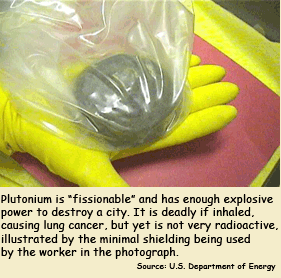 MOX is nuclear reactor fuel containing plutonium oxides mixed with conventionally used uranium oxides. It is called "MOX" for short.
JOAN KING: "MOX plutonium recycling a disaster"
Gainesville Times 3/5/13
Fifty tons of U.S. plutonium have been declared surplus and designated for disposition to prevent its use in bombs. Plutonium has a low specific activity, that is, it is not very "hot" radioactive-wise, therefore it is vulnerable to theft and the idea is to secure the plutonium with a high-radiation field. The basic idea behind MOX is to place the plutonium-laced MOX fuel in commercial nuclear reactors where the fission process will build up deadly radiation to create a radioactive barrier to theft or re-use of the plutonium.
 Because MOX involves processing and trafficking of plutonium, the critical ingredient in nuclear weapons, there is widespread opposition to using plutonium as reactor fuel for proliferation reasons. See PLUTONIUM REACTOR PROBLEM.
Environmental concerns about MOX range from increased risk of reactor accident and increased public health consequences to plutonium processing safety and security concerns and MOX waste management. The environmentally preferred option is PLUTONIUM IMMOBILIZATION in the stranded high-radiation tank wastes at Savannah River Site. Encasing plutonium in the glassification process for these 35,000,000 gallons of highly radioactive wastes left over from Cold War plutonium production would solve two deep problems at once.
Nuclear Watch South has legally opposed MOX licensing since 2001 in two phases of licensing: construction authorization which was followed by the current operation and possession of special material (plutonium) license application. In the ensuing decade several positive outcomes have been gained by the direct action citizens group formerly called Georgians Against Nuclear Energy (GANE). Initially, MOX contractors intended to put highly toxic, radioactive MOX waste into the tank farms at SRS but legal pressure from GANE prompted the addition of a dedicated MOX waste processing building. Seismic concerns raised by GANE prompted the NRC licensing review staff to require current regional seismic modeling, an upgrade which was also applied to the license review for Summer and Vogtle, new commercial reactors under construction in SC and GA respectively. GANE's contention about security filed one month prior to 9/11 launched an ongoing national discussion about requirements to review terrorism and insider sabotage under the National Environmental Policy Act.
"To the village square
we must carry the facts
of atomic energy.
From there must come America's voice."
ALBERT EINSTEIN

~~~~~~
~~~~~~
HOT NEWS
CLI-15-09
U.S. Nuclear Regulatory Commission Order Refuses to Consider Cybersecurity at MOX Plutonium Fuel Factory in South Carolina
4/23/15
released publicly 5/7/15
MOX RECEIVES GOLDEN HAMMER AWARD
Congress keeps funding overbudget plutonium site with no real customers
by Kellan Howell
Washington Times
5/7/15
AEROSPACE Independent Assessment
4/22/15
Commissioner Baran’s
Comments on
“Cyber Security for Fuel Cycle Facilities”
2/19/15
UCS Report
Excess Plutonium Disposition:
The Failure of MOX and the Promise of Its Alternatives
by Edwin S. Lyman
December 2014
IPFM
International Panel on Fissile Materials
Alternatives to MOX
Direct-disposal options for stockpiles of separated plutonium by Frank von Hippel and Gordon MacKerron
April 2015
Surplus Plutonium Disposition Supplemental Environmental Impact Statement
National Nuclear Security Administration
May 8, 2015
~~~~~~
NNSA ADMINISTRATOR: MOX CONSTRUCTION STOP-ORDER COMING
by Derrek Asberry
Aiken Standard
4/3/14
CONSTRUCTION, OPERATIONAL CHALLENGES ENDANGER $7.7B MOX PROJECT
by Scott Judy
ENR Southeast
4/2/14
THE POSTER CHILD FOR GOVERNMENT BOONDOGGLES
by Ryan Alexander
U.S. News & World Report
4/2/14
OBAMA BUDGET PLAN PUTS CONTROVERSIAL PLUTONIUM-CONVERSION FACILITY ON HOLD
by Douglas P. Guarino
Global Security Newswire
3/4/14
OBAMA BUDGET CALLS FOR SHUTTING DOWN KEY TVA NUCLEAR
FUEL SOURCE
Chattanooga
Times-Free Press
3/4/14
MOX PLANT OVERRUNS MAKE IT TOO COSTLY
Rock Hill Herald
3/3/14
~~~~~~
MOX EXPOSED TO
CYBER ATTACKS
by Derrek Asberry
Aiken Standard
7/3/13
NRC PANEL REVIEWS FEARS PLUTONIUM VULNERABLE TO THEFT
by Douglas P. Guarino
NTI
5/22/13
~~~~~~
NY Times on MOX
U.S. Moves to Abandon Costly Reactor Fuel Plant
by Matt Wald
6/25/13
~~~~~~

HOT MOX NEWS!
In-depth look at MOX plutonium fuel boondoggle from Center for Public Integrity
by Douglas Birch and
R. Jeffrey Smith
Nuclear Waste:
How a huge U.S. nonproliferation program became a major proliferation concern
6/24/13
Nuclear Waste:
A $1 billion Energy Department project overshoots its budget by 600 percent
6/25/13
Nuclear Waste: Extremism in defense of federally-paid jobs is no vice in South Carolina
6/26/13
Nuclear Waste: Washington has ignored a cheaper way to dispose of its plutonium — until now
6/27/13
~~~~~~
Friends of the Earth
REPORT
Life-Cycle Cost
Estimate for Department of Energy’s
Mixed Oxide (MOX) Plutonium Fuel Program
April 2013
~~~~~~
MORE ON MOX
It's Time to Pull the
Plug on the MOX "Factory to Nowhere"
by Ed Lyman
PLUTONIUM WAITS
by Glenn Carroll
~~~~~~
PLUTONIUM FACTS
Year plutonium was discovered by Glenn Seaborg and others
1941
Minimum amount of plutonium required for bomb
1 kilogram (2.2 pounds)
Amount of plutonium used in Nagasaki bomb
6.5 kilograms
Average amount of plutonium used in modern atom bomb
3 kilograms
Estimated amount of U.S. weapons-grade plutonium
85,000 kilograms (93.5 tons)
Estimated amount of Russian weapons-grade plutonium
160,000 kilograms (176 tons)
Hazards associated with plutonium
Radiation, fire, inhalation, ingestion, criticality, reactivity, decay
Length of time that
plutonium 239 (weapons-grade) remains hazardous
240,000 years
(Ten 24,000-year half-lives)
Form of plutonium most hazardous to life
Plutonium oxide powder
What happens to plutonium metal when exposed to air
Gradually turns to
plutonium oxide powder
Lethal amount of plutonium oxide powder (inhaled)
2000 micrograms
Lethal amount of plutonium oxide powder (ingested)
500,000 micrograms
Amount of sugar substitute in average 1 gram package
1,000,000 micrograms
Excerpted from Stop Plutonium Fuel: Plutonium Index, compiled by Don Moniak. Blue Ridge Environmental Defense League, www.bredl.org
Both the planet Pluto and the element plutonium are named for the ancient god Pluto, ruler of the underworld and the dead.
In mythology, Pluto was an unwelcome visitor to Earth and to the ancient abode of the gods Olympus, because of his unpitying and inflexible nature.
Pluto was King of the Dead, but not Death itself; terrible, but not evil.